


-
-
Concrete
-
- Concreting
- Concrete Vibrators
- Complete 230 V Mechanical Vibrators
- Vibrator Heads
- Vibrator Shafts
- Vibrator Motors
- Concrete Vibrators 42 V | 200 Hz
- Mechanical Vibrators 230 V
- 42 V | 200 Hz Head and Shaft
- 230 V Concrete Vibrators
- Vibrators With Built-In 230 V | 200 Hz Converter
- 42 V | 200 Hz Converters
- Combustion Vibrators
- Pneumatic Vibrators
- External Vibrators
- Power Trowels
- Vibratory Screeds
- Concrete Hand Tools
- Concrete Vibrators
-
-
-
-
-
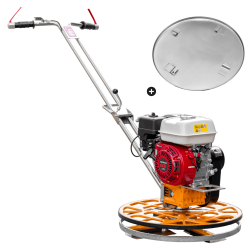
- Walk-Behind Combustion Power Trowels
-
-
-

Heating and cooling
-
Generators
-
Earthworks
-
Industrial vacuums
-
Finishing
-
Pumps
-
Measurement
-
BLOG & Tips
-
Promotions
Kategorie 16 kategorii
Kategorie
-
- Levels and Measurements
- Soil Compactors
- Tamping Rammers - Jumping Jacks
- Single Direction Vibratory Plates
- Reversible Vibratory Plates
- Rollers
- 100 kg Soil Compactors
- 200 kg Soil Compactors
- 300 kg Soil Compactors
- 400 kg Soil Compactors
- 500 kg Soil Compactors
- 600 kg Soil Compactors
- 700 kg Soil Compactors
- 800 kg Soil Compactors
- Wacker Neuson Compactors
- Accessories for Compactors
- Bomag Compactors
- Altrad Belle Compactors
- Paver Compactors
- Swepac Compactors
- Power Generators
- Concreting
- Concrete Vibrators
- Complete 230 V Mechanical Vibrators
- Vibrator Heads
- Vibrator Shafts
- Vibrator Motors
- Concrete Vibrators 42 V | 200 Hz
- Mechanical Vibrators 230 V
- 42 V | 200 Hz Head and Shaft
- 230 V Concrete Vibrators
- Vibrators With Built-In 230 V | 200 Hz Converter
- 42 V | 200 Hz Converters
- Combustion Vibrators
- Pneumatic Vibrators
- External Vibrators
- Vibratory Screeds
- Power Trowels
- Concrete Hand Tools
- Concrete Vibrators
- Pumps and Motor Pumps
- Cutting, Drilling and Grinding
- Heating and Cooling
- Wood Table Saws
- Painting and Plastering
- Combustion Engines
- Washing and Vacuuming
- Cement Mixers
- Paving Tools
- Wheelbarrows and Track Dumpers
- Demolition and Hammers
- Sales
- Levels and Measurements
Brak kategorii pasujących do wyszukiwania.
400 V Cement Mixers
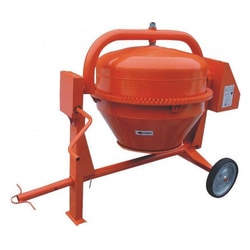
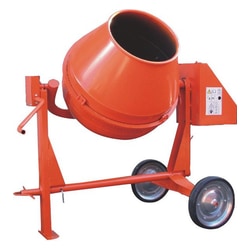
Altrad Belle SUPERIOR 350E Concrete Mixer (400 V)
MU82zł7,228.00 tax incl. 5 876,42 zł tax excl.View technical data Zobacz szczegóły
- Weight: 260 kg
- Dimensions: 1820 x 1110 x 1580 mm
- Engine power: 1,5 kW
- Working capacity: 350 l
- Total capacity: 500 l
Altrad Belle BWE-250K Concrete Mixer (400 V)
MU48zł6,618.00 tax incl. 5 380,49 zł tax excl.View technical data Zobacz szczegóły
- Weight: 240 kg
- Dimensions: 1850 x 1000 x 1570 mm
- Engine power: 1,5 kW
- Working capacity: 250 l
- Total capacity: 400 l
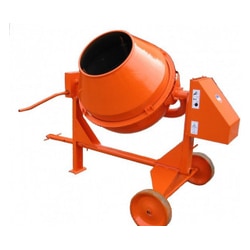
Altrad Belle BWE-150K Concrete Mixer (400 V)
MU44zł5,098.01 tax incl. 4 144,72 zł tax excl.View technical data Zobacz szczegóły
- Weight: 185 kg
- Dimensions: 1375 x 900 x 1440 mm
- Engine power: 1,1 kW
- Working capacity: 150 l
- Total capacity: 300 l
Altrad Belle BWE-200K Concrete Mixer (400 V)
MU46zł5,098.01 tax incl. 4 144,72 zł tax excl.No technical data available Zobacz szczegóły
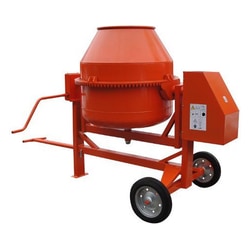
Altrad Belle SUPERIOR 300E Concrete Mixer (400 V)
MU78zł6,900.00 tax incl. 5 609,76 zł tax excl.View technical data Zobacz szczegóły
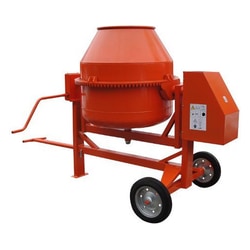
- Weight: 250 kg
- Dimensions: 1820 x 1110 x 1580 mm
- Engine power: 1,5 kW
- Working capacity: 300 l
- Total capacity: 450 l
A 400 V cement mixer is a free-fall machine driven by a three-phase motor and fed from the site supply through a 5-pin CEE socket rated 16 A (three phases, neutral, earth). Three-phase power delivers full torque the moment the drum starts turning, keeps the machine mixing right through a shift and — at the same motor rating — draws roughly three times less current per conductor than a single-phase version. That is why on spread-out sites, where the supply cable runs 30–50 m, a three-phase mixer holds its drum speed even with a coarse-aggregate batch inside.
At NORWIT.PL this category is built mainly around Altrad Belle mixers from the BWE line — ring-gear drives made for masonry mortar, screeds and concrete for smaller pours. If your site only offers a 230 V outlet, look at single-phase cement mixers; with no mains connection at all, see petrol cement mixers. Below we explain how to match motor rating, circuit protection and cable to a three-phase mixer.
What three-phase power does for a cement mixer
A three-phase motor develops full torque from standstill without a start winding or a capacitor, so a drum loaded with 8–16 mm aggregate turns over even after the batch has stiffened during a break. The second difference is electrical: a 1.1 kW motor on 400 V draws roughly 2.5 A per phase, while its 230 V counterpart needs some 7.5 A through one conductor. Cable losses grow with the square of the current, so on a 50 m extension the voltage drop is a fraction of the single-phase figure.
The third advantage is duty cycle: a three-phase machine mixes all shift without pauses for cooling, and with a batch time of 2–4 minutes it turns out several cubic metres of mortar a day.
400 V, 230 V or petrol cement mixer
| Criterion | 400 V (three-phase) | 230 V (single-phase) | Petrol |
|---|---|---|---|
| Power supply | 5-pin CEE socket, 16 A | 230 V socket, 16 A | no electricity needed |
| Typical motor rating | approx. 0.75–1.5 kW | approx. 0.55–1.1 kW | approx. 3–5 hp |
| Torque with a full drum | high, starts under load | limited | high |
| Continuous work all shift | yes | with breaks | yes, with fuel supplied |
| Indoor use | yes | yes | no, exhaust fumes |
| Typical application | site with a power connection, bricklaying crew | refurbishment, single-family house | sites with no power supply |
Next to a site distribution board the 400 V version costs less to run; for occasional jobs at home a single-phase cement mixer is simpler.
Installation and setting up the mixing station
A three-phase mixer needs a 16 A CEE socket wired in the right phase sequence — reverse it and the drum turns the wrong way, so check the direction of rotation at first start-up. Protect the circuit with a type C 16 A breaker and a 30 mA residual current device. Set the drum level on firm ground; any tilt spoils the mixing geometry.
A mixer works alongside the rest of the concreting kit: the batch goes into wheelbarrows, it is compacted with concrete vibrators, and the surface is finished with a vibratory screed and a power trowel. The full line-up sits in Altrad Belle cement mixers.
Frequently asked questions about 400 V cement mixers
How much current does a 400 V cement mixer draw and what protection does it need?
Current draw follows the motor rating: a 1.1 kW three-phase mixer takes about 2.5 A per phase in steady running, a 1.5 kW machine around 3.5 A. Inrush reaches several times that, which is why the standard is a 16 A CEE socket with a type C 16 A breaker — a characteristic that rides out the starting peak. A site circuit is additionally protected by a 30 mA residual current device.
How does a three-phase mixer differ from a single-phase one in daily work?
The gap shows up on starting under load and over long runs. A three-phase motor comes up with full torque, so it turns a drum full of mortar even after a break of several minutes, and at 1.1 kW it loads each conductor with roughly 2.5 A instead of the 7.5 A a 230 V machine needs. Lower current means smaller losses in the cable: on a 50 m extension the drum keeps its speed. A 400 V machine is also rated for continuous duty across a whole shift, whereas a single-phase unit running 2–4 minute batches needs pauses for the winding to cool down.
Which extension cable should feed a 400 V cement mixer on site?
Three-phase machines are fed with five-core rubber-sheathed H07RN-F cable terminated in 16 A CEE plugs and sockets. A 5×2.5 mm² cross-section covers runs of about 50 m with motors up to 1.5 kW; beyond that, move to 5×4 mm². Always unwind the cable fully — a coiled reel heats up and loses 30–40 percent of its rating. Keep couplings off the ground: connectors lying in water are the most common reason a residual current device trips.
Can a 400 V cement mixer run off a generator?
Generator supply is the normal solution on plots without a mains connection, provided there is headroom for the starting surge. The unit needs a three-phase 400 V output with a 16 A CEE socket, and its rating is picked three to four times above the motor: for a 1.1 kW mixer that usually means around 4–6 kVA. An undersized generator sags in voltage when the drum starts under load and cuts out. Equipment for that kind of station is listed under generators.