


-
-
Concrete
-
- Concreting
- Concrete Vibrators
- Complete 230 V Mechanical Vibrators
- Vibrator Heads
- Vibrator Shafts
- Vibrator Motors
- Concrete Vibrators 42 V | 200 Hz
- Mechanical Vibrators 230 V
- 42 V | 200 Hz Head and Shaft
- 230 V Concrete Vibrators
- Vibrators With Built-In 230 V | 200 Hz Converter
- 42 V | 200 Hz Converters
- Combustion Vibrators
- Pneumatic Vibrators
- External Vibrators
- Power Trowels
- Vibratory Screeds
- Concrete Hand Tools
- Concrete Vibrators
-
-
-
-
-
- Walk-Behind Combustion Power Trowels
-
-
-
Heating and cooling
-
Generators
-
Earthworks
-
Industrial vacuums
-
Finishing
-
Pumps
-
Measurement
-
BLOG & Tips
-
Promotions
Kategorie 16 kategorii
Kategorie
-
- Levels and Measurements
- Soil Compactors
- Tamping Rammers - Jumping Jacks
- Single Direction Vibratory Plates
- Reversible Vibratory Plates
- Rollers
- 100 kg Soil Compactors
- 200 kg Soil Compactors
- 300 kg Soil Compactors
- 400 kg Soil Compactors
- 500 kg Soil Compactors
- 600 kg Soil Compactors
- 700 kg Soil Compactors
- 800 kg Soil Compactors
- Wacker Neuson Compactors
- Accessories for Compactors
- Bomag Compactors
- Altrad Belle Compactors
- Paver Compactors
- Swepac Compactors
- Power Generators
- Concreting
- Concrete Vibrators
- Complete 230 V Mechanical Vibrators
- Vibrator Heads
- Vibrator Shafts
- Vibrator Motors
- Concrete Vibrators 42 V | 200 Hz
- Mechanical Vibrators 230 V
- 42 V | 200 Hz Head and Shaft
- 230 V Concrete Vibrators
- Vibrators With Built-In 230 V | 200 Hz Converter
- 42 V | 200 Hz Converters
- Combustion Vibrators
- Pneumatic Vibrators
- External Vibrators
- Vibratory Screeds
- Power Trowels
- Concrete Hand Tools
- Concrete Vibrators
- Pumps and Motor Pumps
- Cutting, Drilling and Grinding
- Heating and Cooling
- Wood Table Saws
- Painting and Plastering
- Combustion Engines
- Washing and Vacuuming
- Cement Mixers
- Paving Tools
- Wheelbarrows and Track Dumpers
- Demolition and Hammers
- Sales
- Levels and Measurements
Brak kategorii pasujących do wyszukiwania.
Truss Screeds
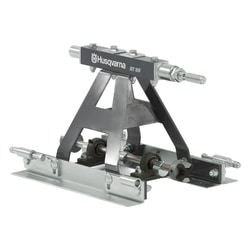
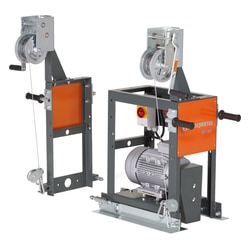
Napęd Husqvarna BT 90 z sekcją końcową
967941102zł18,295.38 tax incl. 14 874,29 zł tax excl.View technical data Zobacz szczegóły
- Typ napędu: Elektryczny 400 V | Spalinowy Honda GX 270
Sekcja Husqvarna BT 90 (0,5–3 m)
967941104zł3,501.43 tax incl. 2 846,69 zł tax excl.View technical data Zobacz szczegóły
- Length: 0,5 m | 0,75 m | 1 m | 2 m | 3 m
- Kompatybilność: Napęd Husqvarna BT 90
A truss screed is the heavy-duty end of the vibratory screed family: a rigid lattice beam, bolted together from modules, that never floats on the mix. Instead it rests at both ends on guides — steel rails, formwork edges or a previously poured strip of concrete. A vibrator mounted on the frame drives the whole working width at once, and the machine is pulled along the pour by a winch or rope. Levelling accuracy therefore comes from the guides rather than from the operator's hands, which is what makes repeatable flatness possible across spans of 5–20 m.
This is the tool for foundation slabs, industrial floors, yards, roads and bridge decks — jobs where floating vibratory screeds and double beam screeds simply take too long: they work narrower strips, roughly 3.6 m and 7.2 m respectively. The range here covers modules and complete sets mainly from Swepac and Husqvarna Construction. Below we explain how to size the working width, how to set the guides and when a truss screed genuinely pays for itself.
How a truss screed works
The beam is built like a roof truss: a top chord, a bottom chord and diagonal bracing. That gives high bending stiffness at low self-weight, so a beam spanning over ten metres does not sag under fresh concrete. A screeding profile runs along the underside, and the drive sits on the frame — a petrol engine in the 1.5–6 hp class or a 230/400 V electric unit. Vibration travels the full length of the profile, so the mix is de-aerated and compacted across the whole strip at once.
Forward travel comes from a cable winch or two operators pulling the machine along guides set on both sides of the pour. The finished level follows those guides, set with a laser level, not the operator's feel.
Modules and working width
Truss screeds are modular. Two end modules carry the drive, handles and winch attachment; between them go intermediate sections, typically 1–3 m long, bolted on site. The compacted layer is usually 10–30 cm thick — deeper pours need a concrete vibrator as well, since surface vibration does not reach the full cross-section.
Truss, double beam or floating screed
| Feature | Truss screed | Double beam screed | Floating screed |
|---|---|---|---|
| Strip width | approx. 5–20 m | approx. 1.5–7.2 m | approx. 1.5–3.6 m |
| Runs on | guide rails / formwork | the concrete | the concrete |
| Level set by | the guides | the operator | the operator |
| Crew | two people and a winch | two people | one person |
| Typical work | slabs, industrial floors, roads | screeds, suspended floors | small bays, repairs |
A truss screed wins on output and repeatable flatness over a large bay, and loses on preparation: guides must be levelled before concrete arrives. Below roughly 150 m2 that setup eats the advantage, and lighter vibratory screeds make more sense.
Frequently asked questions about truss screeds
When does a truss screed pay off compared with a hand-guided beam?
The break-even point is the size of a single pour. From around 300 m2 in one casting, an 8–12 m truss screed finishes the bay in one pass, while a double beam screed with a 4 m profile needs three passes and leaves joints between strips. Flatness tolerance is the second argument: the level is held by guides set with a laser level, so deviation does not grow as the operator tires. On bays up to roughly 150 m2 the arithmetic reverses — the 1–2 hours spent levelling guides take longer than the pour itself.
What does a truss screed rest on while it works?
Support comes from two guides along the edges of the bay: steel rails on adjustable feet, formwork edges, or a concrete strip poured the previous day. The end modules carry skids that slide along those guides, so their spacing should be 20–40 cm narrower than the working width. Guides are levelled before concreting and checked every 2–3 m, because a height error transfers one-to-one into the finished floor. Indoors the rails are tied to the reinforcement so the mix cannot shift them.
What working widths can be assembled from the modules?
Width depends on how many intermediate sections go between the two end modules. Sections are usually 1–3 m long, so common configurations land at 5 m, 8 m, 12 m and beyond, with the upper limit set by the manufacturer for each drive unit. Exceeding it lets the beam deflect and leaves a wave in the slab. Weight matters as much: a set spanning more than ten metres typically weighs 150–300 kg, which means a winch and two people at every repositioning.
Does concrete still need power trowelling after a truss screed?
Trowelling stays a separate stage. A truss screed compacts and levels a 10–30 cm layer and brings cement laitance to the top, but it does not close the pores — the surface is flat, yet matt and absorbent. Once bleed water has evaporated, typically 2–5 hours after placing and confirmed by a boot-print of about 5 mm, a power trowel goes in: first with a float disc, then with blades. That stage decides how an industrial floor resists abrasion; skipping it gives a slab that dusts within months.
Why buy a truss screed at NORWIT.PL
We advise contractors on bay size and flatness tolerance, not headline price: configuring modules for the width you actually pour, matching the drive unit and adding complete vibratory screeds for smaller bays. Orders ship from Poland with a VAT invoice.