


-
-
Concrete
-
- Concreting
- Concrete Vibrators
- Complete 230 V Mechanical Vibrators
- Vibrator Heads
- Vibrator Shafts
- Vibrator Motors
- Concrete Vibrators 42 V | 200 Hz
- Mechanical Vibrators 230 V
- 42 V | 200 Hz Head and Shaft
- 230 V Concrete Vibrators
- Vibrators With Built-In 230 V | 200 Hz Converter
- 42 V | 200 Hz Converters
- Combustion Vibrators
- Pneumatic Vibrators
- External Vibrators
- Power Trowels
- Vibratory Screeds
- Concrete Hand Tools
- Concrete Vibrators
-
-
-
-
-
- Walk-Behind Combustion Power Trowels
-
-
-
Heating and cooling
-
Generators
-
Earthworks
-
Industrial vacuums
-
Finishing
-
Pumps
-
Measurement
-
BLOG & Tips
-
Promotions
Kategorie 16 kategorii
Kategorie
-
- Levels and Measurements
- Soil Compactors
- Tamping Rammers - Jumping Jacks
- Single Direction Vibratory Plates
- Reversible Vibratory Plates
- Rollers
- 100 kg Soil Compactors
- 200 kg Soil Compactors
- 300 kg Soil Compactors
- 400 kg Soil Compactors
- 500 kg Soil Compactors
- 600 kg Soil Compactors
- 700 kg Soil Compactors
- 800 kg Soil Compactors
- Wacker Neuson Compactors
- Accessories for Compactors
- Bomag Compactors
- Altrad Belle Compactors
- Paver Compactors
- Swepac Compactors
- Power Generators
- Concreting
- Concrete Vibrators
- Complete 230 V Mechanical Vibrators
- Vibrator Heads
- Vibrator Shafts
- Vibrator Motors
- Concrete Vibrators 42 V | 200 Hz
- Mechanical Vibrators 230 V
- 42 V | 200 Hz Head and Shaft
- 230 V Concrete Vibrators
- Vibrators With Built-In 230 V | 200 Hz Converter
- 42 V | 200 Hz Converters
- Combustion Vibrators
- Pneumatic Vibrators
- External Vibrators
- Vibratory Screeds
- Power Trowels
- Concrete Hand Tools
- Concrete Vibrators
- Pumps and Motor Pumps
- Cutting, Drilling and Grinding
- Heating and Cooling
- Wood Table Saws
- Painting and Plastering
- Combustion Engines
- Washing and Vacuuming
- Cement Mixers
- Paving Tools
- Wheelbarrows and Track Dumpers
- Demolition and Hammers
- Sales
- Levels and Measurements
Brak kategorii pasujących do wyszukiwania.
Masonry Saws for Refractory Materials
Norton Clipper JUMBO 651 400V Table Saw
70184614005zł14,998.99 tax incl. 12 194,30 zł tax excl.No technical data available Zobacz szczegóły
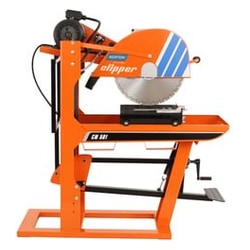
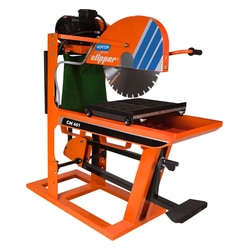
Electric Masonry Cutter NORTON CLIPPER CM501 Major
70184627018zł14,015.00 tax incl. 11 394,31 zł tax excl.View technical data Zobacz szczegóły
- Engine type: Elektryczny
- Voltage: 400 V
- Power: 4 kW (5,5 HP)
- Speed: 1900 min-1
- Maximum cutting length: 500 mm
Electric Masonry Cutter NORTON CLIPPER CM501 Major 3.55.3 D.V.
70184628233zł16,856.01 tax incl. 13 704,07 zł tax excl.View technical data Zobacz szczegóły
- Weight: 163 kg
- Engine type: Elektryczny
- Voltage: 230-400v~3
- Power: 4 kW (5,5 HP)
- Speed: 1900 min-1
Electric Masonry Cutter NORTON CLIPPER CM501 Major 3-20-1
70184628235zł16,105.62 tax incl. 13 094,00 zł tax excl.View technical data Zobacz szczegóły
- Engine type: Elektryczny
- Voltage: 115 V
- Power: 2,2 kW (3 HP)
- Speed: 1900 min-1
- Maximum cutting length: 500 mm
Norton Clipper CM 601 Major Electric Masonry Cutter 5.55.3 (400 V | 600 Mm)
70184607577zł14,577.38 tax incl. 11 851,53 zł tax excl.View technical data Zobacz szczegóły
- Engine type: Elektryczny
- Voltage: 400 V / 4 kW
- Power: 4 kW / (5,5 HP)
- Speed: 1900 min-1
- Maximum cutting length: 500 mm
Electric Masonry Cutter NORTON CLIPPER ISC Super
70184613986zł37,562.99 tax incl. 30 539,02 zł tax excl.View technical data Zobacz szczegóły
- Voltage: 400 V 3~
- Power: 5,5 kW (7,5HP)
- Speed: 2062 min-1
- Maximum cutting length: 750 mm
- Cutting depth: 190 mm
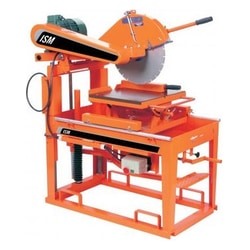
Electric Masonry Cutter NORTON CLIPPER ISM
70184613985zł37,232.00 tax incl. 30 269,92 zł tax excl.View technical data Zobacz szczegóły
- Voltage: 400 V 3~
- Power: 5,5 kW (7,5HP)
- Speed: 2062 min-1
- Maximum cutting length: 500 mm
- Cutting depth: 190 mm
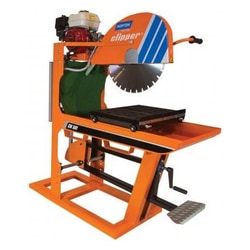
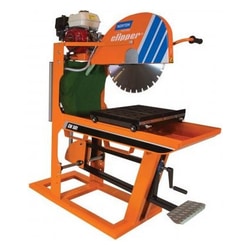
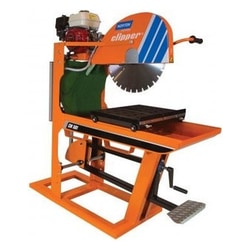
NORTON CLIPPER CM501 Major CM501 3.60.P Petrol Cutter For Masonry Products.
70184627020zł16,933.00 tax incl. 13 766,67 zł tax excl.View technical data Zobacz szczegóły
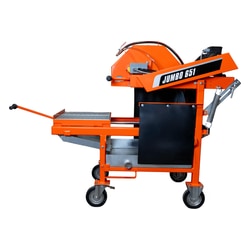
- Engine type: Spalinowy
- Voltage: 4,8 kW
- Engine: Honda GX 200
- Power: 6,5 HP
- Speed: 2200 min-1
Masonry saws for refractory materials are bench-type cut-off machines built for fire clay brick, refractory shapes, vermiculite board and heat-resistant concrete — materials abrasive enough to wear out an ordinary diamond blade within a few dozen cuts. Fire clay brick typically holds 30–45% alumina and serves in furnace linings running at 1300–1500°C; its hard mullite grain treats a diamond segment much like sandpaper.
What decides the result here is not the machine type alone but the pairing: a blade with a soft bond matrix that keeps exposing fresh diamond, plus generous water cooling that carries away heat and binds silica dust at the source. The tables on these saws feed the piece slowly and evenly, because refractory brick chips under a jerk and the finished edge has to go straight into the wall.
Buyers are stove builders, furnace masons and crews relining boilers. At NORWIT.PL this category is built mainly around masonry cut-off saws from norton clipper. Other bench designs sit in the masonry saws category.
What sets refractory materials apart from ordinary building ceramics
Fire clay brick is made from refractory clay fired at roughly 1300–1450°C, with alumina content usually between 30 and 45%. Its mullite grain reaches about 6–7 on the Mohs scale, harder than aggregate in ordinary concrete, yet a brick of the common 250 × 124 × 65 mm format stays brittle — a snatched feed breaks off the corner.
The group also covers arch wedges, vermiculite boards, heat-resistant concretes and boiler linings — far more aggressive towards a segment than hollow ceramic blocks or aerated concrete units, the domain of masonry band saws.
Blades for fire clay — the case for a soft bond
A diamond segment is a set of crystals held in a sintered metal bond — it has to erode as fast as the crystals go blunt, because only erosion uncovers the next sharp layer. Concrete calls for a hard bond; refractory material is the opposite case, since it grinds the bond away on its own. A concrete blade loses its segment height within a few dozen cuts in fire clay, while a refractory blade with a soft bond keeps sharpening itself.
Wrong selection announces itself: with too hard a bond the saw stalls in the kerf and the brick edge scorches.
Fire clay against other materials — what the machine has to deliver
| Criterion | Fire clay brick, refractory shapes | Hollow ceramic block, sand-lime unit | Concrete, reinforced concrete, pavers |
|---|---|---|---|
| Abrasion against the segment | very high | high | moderate |
| Recommended blade bond | soft, for abrasive materials | medium | hard |
| Water cooling | mandatory and generous | yes, or dry band cutting | yes |
| Typical cutting depth range | approx. 100–200 mm | approx. 200–350 mm | approx. 100–330 mm |
Work out the depth from the shape you cut: a brick laid flat needs roughly 65–70 mm, cut across 125–130 mm, lining boards and blocks around 150 mm. For ordinary masonry units too, see the compact designs under masonry saws up to 400 mm.
Frequently asked questions
Why should fire clay brick never be cut with a concrete blade?
Abrasiveness governs the choice here, not hardness. Mullite grain in fire clay of 30–45% alumina rates about 6–7 on the Mohs scale and wears the metal bond faster than the diamond crystals go blunt. A concrete blade carries a hard bond meant for a less abrasive material, so in fire clay it burns through its working segment height after a few dozen cuts. A refractory blade uses a soft bond that erodes in step with the crystals, uncovering fresh diamond and holding a steady cutting rate.
Can refractory shapes be cut dry?
Wet cutting is the working answer for refractory materials, for two reasons. Heat comes first: without water the bond softens and sheds crystals, and a brittle shape cracks from thermal stress. Dust comes second — fire clay holds roughly 50–60% silica, and its respirable fraction carries an occupational exposure limit of 0.1 mg/m³, while water binds much of the dust at source. A single dry trimming cut in a shape up to about 65 mm can be acceptable with class M extraction and a half mask, but a batch of several dozen cuts sends you back to water.
What power supply and water system suit a furnace repair job?
Lining repairs usually happen in a boiler room or hall with no water connection nearby. Single-phase 230 V machines rated around 2.2 kW run off a standard site socket and off a generator delivering at least 3.5 kW continuous, while 400 V versions hold torque in reserve through long series of cuts in shapes thicker than 100 mm. Either drive still needs a submersible pump feeding from a recirculating tray of several dozen litres.
How should shapes be trimmed so the refractory mortar joint comes out right?
Refractory linings are laid on thin joints — fire clay mortars go on in a layer of roughly 1–3 mm, several times thinner than the 10–12 mm of ordinary masonry. The sawn edge therefore has to come out straight and free of chipping, because every missing fragment gets filled with mortar of different thermal expansion — that is where the first crack shows up. In practice: slow, even feed, the piece held against the guide through the whole kerf, no backing the blade out mid-cut. Cut arch wedges as one batch on a single 45° guide setting.
Why buy a refractory cut-off saw at NORWIT.PL
We specify the machine and the blade together, because here they are one decision — a capable saw with the wrong bond chews through consumables in hours. Our range centres on masonry cut-off saws from norton clipper; remaining bench designs sit under masonry saws. Write through the contact form, stating the material and piece thickness.