



No products available yet
Stay tuned! More products will be shown here as they are added.
WAREHOUSE
SUPPORT
14 DAYS
ON THE MARKET
All
Construction machinery
Generators
Heating and cooling
Washing and vacuuming
Levels and measurements
BLOG & Tips
Promotions
Stay tuned! More products will be shown here as they are added.
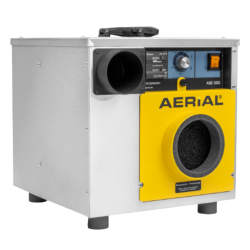
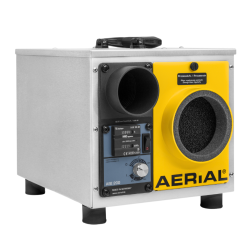
Desiccant (adsorption) dehumidifiers use a silica gel rotor (sorbent) that binds moisture from the air — the only drying technology that works effectively at low temperatures, down to -20°C. At NORWIT.PL: professional desiccant dehumidifiers from Dantherm Aerial ASE and Trotec TTR with capacity from 0.35 to 2.2 kg/h. Ideal for cold stores, refrigerated warehouses, archives, pharmaceutical storage, unheated halls and any space requiring low relative humidity.
Norwit is the authorised distributor of two leading desiccant dehumidifier brands: Dantherm Aerial ASE (Denmark) and Trotec TTR (Germany). All models are equipped with a silica gel rotor — the highest quality sorbent that binds moisture from the air even at sub-zero temperatures. Capacity range: 0.35 to 2.2 kg of water per hour (8-53 kg/24h). Full drying performance from -20°C to +35°C. Warehouse in Kraków-Niepołomice, 24 h dispatch.
| Model | Max. capacity | Air flow | Power draw | Weight |
|---|---|---|---|---|
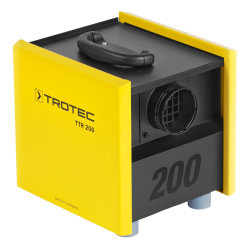
| Trotec TTR 200 | 0.35 kg/h (8.4 kg/24h) | 180 m³/h | 0.85 kW | 30 kg |
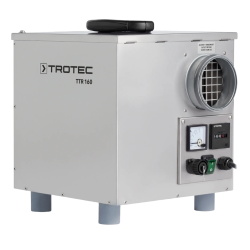
| Trotec TTR 160 | 0.50 kg/h (12 kg/24h) | 180 m³/h | 1.0 kW | 28 kg |
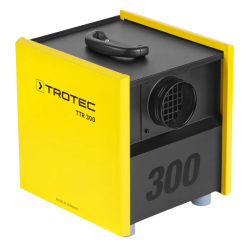
| Trotec TTR 300 | 0.70 kg/h (16.8 kg/24h) | 250 m³/h | 1.3 kW | 43 kg |
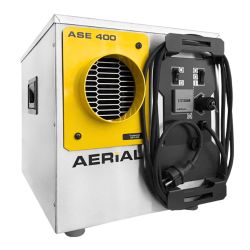
| Dantherm Aerial ASE 200 | 0.78 kg/h (18.75 kg/24h) | 200 m³/h | 1.1 kW | 32 kg |
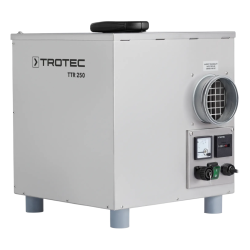
| Trotec TTR 250 | 1.10 kg/h (26.4 kg/24h) | 350 m³/h | 1.9 kW | 52 kg |
| Model | Max. capacity | Air flow | Power draw | Key feature |
|---|---|---|---|---|
| Dantherm Aerial ASE 300 | 1.07 kg/h (25.7 kg/24h) | 300 m³/h | 1.8 kW | External hygrostat included |
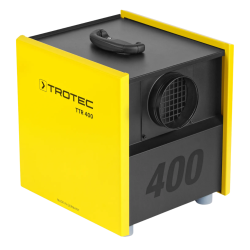
| Trotec TTR 400 | 1.20 kg/h (28.8 kg/24h) | 400 m³/h | 2.2 kW | Standard industrial model |
| Dantherm Aerial ASE 400 | 1.50 kg/h (36 kg/24h) | 400 m³/h | 2.3 kW | Stationary / ducted construction |
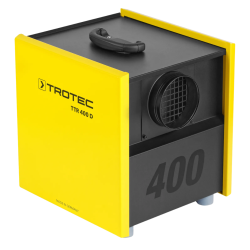
| Trotec TTR 400 D | 1.60 kg/h (38.4 kg/24h) | 400 m³/h | 2.4 kW | "D" = separate regeneration ducts (higher capacity) |
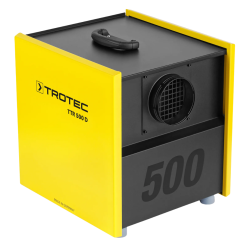
| Trotec TTR 500 D | 2.20 kg/h (52.8 kg/24h) | 500 m³/h | 3.2 kW | Strongest in the mobile class |
All models compliant with the standard EN 60335-2-40 (safety of air conditioning equipment) and the EMC Directive (2014/30/EU). Operating temperature range: -20°C to +35°C, optimal inlet humidity 30-90% RH. Drying medium: silica gel, rotor service life 30,000-50,000 operating hours.
A desiccant dehumidifier draws moist air through a rotating rotor (1-6 rotations per hour) built from hundreds of thousands of thin channels filled with silica gel — a porous sorbent with an active surface area of about 750-800 m² per gram. Water vapour molecules are physically "captured" by the gel pores (adsorption), and dried air returns to the room. The second part of the rotor simultaneously passes through the regeneration zone — hot air (110-140°C generated electrically) evaporates moisture from the gel, and water vapour is exhausted outside through a separate duct. The cycle is continuous — the rotor constantly rotates between drying and regeneration zones, so the unit runs 24/7 without breaks for tank emptying.
Key feature: adsorption works independently of temperature — silica gel binds water vapour physically, regardless of whether the air is at -20°C or +30°C. This is the only air drying technology that works in cold stores, freezing winter warehouses or unheated halls. The downside is 2-4× higher energy consumption (regeneration requires electric power) and 2-4× higher price compared to a condensation dehumidifier of the same capacity at 20°C.
| Situation | Choose desiccant | Choose condensation |
|---|---|---|
| Room temperature < 5°C | ✓ only option | ✗ condensation stops working |
| Cold store / freezer (-20°C to +5°C) | ✓ required choice | ✗ |
| Target: end humidity < 35% RH | ✓ adsorption reaches 1-5% RH | ⚠ condensation stops at 35-45% RH |
| Archive, museum, pharmaceutical warehouse | ✓ stable low humidity | ⚠ too high final humidity |
| Home, office, heated hall >15°C | ⚠ overkill, expensive | ✓ enough + cheaper |
| Drying concrete screed in winter (10-18°C) | ⚠ optional if temp. low | ✓ usually fine with hot gas defrost |
| Unheated production hall in winter | ✓ retains capacity | ✗ frosts, weakens |
| Limited budget, typical room | — | ✓ 2-4× cheaper purchase, lower bills |
A desiccant dehumidifier is an air drying device that uses a rotating rotor filled with silica gel — a porous sorbent with an active surface of 750-800 m² per gram, which physically binds water vapour molecules. Air passes through the drying section of the rotor, gives up moisture to the gel and returns to the room in a dry state. The second section of the rotor is simultaneously regenerated by hot air (110-140°C), which evaporates moisture from the gel and exhausts it outside through a separate duct. The rotor rotates 1-6 times per hour, making operation continuous 24/7. Key feature: works effectively at temperatures from -20°C to +35°C, unlike a condensation dehumidifier which loses capacity below +5°C.
Choose a desiccant dehumidifier in three situations: 1) Room temperature is low — below +5°C (cold store, freezer, refrigeration room) or in the 5-15°C range where condensation is inefficient due to coil frosting. 2) Very low final humidity required — below 35% RH, e.g. archives (35-45% RH), museums (40-50% RH), pharmaceutical warehouses (30-40% RH), electronics production (5-15% RH). Condensation dehumidifiers stop at 35-45% RH; desiccants can reach 1-5% RH. 3) Unheated hall in winter — adsorption retains capacity regardless of temperature, condensation in January practically does not work. In all other applications (homes, halls heated >15°C, drying screed in warm season) choose condensation — 2-4× cheaper purchase and 3-5× cheaper to operate.
Desiccant dehumidifiers operate effectively across the full -20°C to +35°C range, with highest capacity at 10-25°C. Dantherm Aerial ASE and Trotec TTR models are certified for operation in cold stores (e.g. fish warehouse -25°C, vegetable warehouse 0-4°C). At temperatures <0°C adsorption capacity actually increases by 10-15% relative to nominal conditions — low temperatures favour binding of water vapour by silica gel (greater partial pressure difference). This is a key advantage over condensation dehumidifiers, which at <5°C practically stop working (the coil frosts faster than the unit can dry). The upper limit of +35°C is conventional — above this temperature efficiency drops, because rotor regeneration (which is already hot) is less effective in a hot environment.
A desiccant dehumidifier uses 1.5-3.5 kWh of energy per litre of water removed — 3-5× more than a condensation dehumidifier of the same capacity (0.4-0.7 kWh/L). The reason: rotor regeneration requires heating air to 110-140°C with an electric heater, which consumes most of the unit's power. Specifically: Trotec TTR 200 (0.35 kg/h) draws 850 W, Dantherm Aerial ASE 200 (0.78 kg/h) draws 1,100 W, Trotec TTR 500 D (2.2 kg/h) draws 3,200 W. At continuous operation, the monthly bill for a Trotec TTR 400 (1.2 kg/h, 2.2 kW) is ~1,580 kWh/month — a significant cost to consider when choosing the technology. Higher energy consumption is offset by the fact that adsorption is the only technology working at low temperatures and target low humidity.
Yes — a desiccant dehumidifier has two air ducts, unlike a condensation unit which collects water in a tank. The first duct is the dried air outlet (returns to the room being dried), the second is the moist regeneration air exhaust (must go outside, to another room, or through a window/wall). Typical diameters: 80-150 mm, duct length for Trotec TTR / Dantherm Aerial ASE up to 5-6 m. Reason: water vapour evaporated from the gel cannot return to the dried room, as it would immediately raise the humidity again. In practice: the regeneration hose is led to an adjacent room (corridor, another room) or through a ventilation supply/exhaust. "D" models (Trotec TTR 400 D, 500 D) have separate fans for both circuits — providing higher capacity and allowing longer ducts.
Desiccant dehumidifiers can reach very low end humidity — typically 5-20% RH, and under laboratory conditions even down to 1% RH (closed chamber, continuous regeneration). This is the absolute domain of adsorption — no condensation dehumidifier will go below 35-45% RH without extreme coil supercooling. Practical figures in real rooms: Trotec TTR 200 (0.35 kg/h) maintains 30-40% RH in a 50 m² room; Dantherm ASE 300 (1.07 kg/h) maintains 35-45% RH in a 200 m² hall; Trotec TTR 500 D (2.2 kg/h) maintains 20-30% RH in a 400 m² warehouse. Applications: pharmaceutical warehouse (constant 30-35% RH), electronics warehouse (10-20% RH — PCB corrosion protection), military ammunition storage (30-40% RH), document archive (35-45% RH per ISO 11799).
Desiccant dehumidifiers are 2-4× more expensive than condensation units of comparable capacity — a consequence of the more expensive rotor technology and regeneration heater. Net prices at NORWIT.PL (EUR equivalents): Trotec TTR 200 (0.35 kg/h) approx. €1,290, Trotec TTR 160 (0.5 kg/h) approx. €1,290, Trotec TTR 300 (0.7 kg/h) approx. €1,510, Dantherm Aerial ASE 200 (0.78 kg/h) approx. €1,430, Trotec TTR 250 (1.1 kg/h) approx. €1,500, Dantherm Aerial ASE 300 (1.07 kg/h) approx. €1,640, Trotec TTR 400 (1.2 kg/h) approx. €1,840, Dantherm Aerial ASE 400 (1.5 kg/h) approx. €1,860, Trotec TTR 400 D (1.6 kg/h) approx. €2,280, Trotec TTR 500 D (2.2 kg/h) approx. €2,480. For comparison: condensation Master DH 26 with comparable 27 L/24h capacity costs around €860 net. Daily rental: €45-€100/day. Purchase pays off at 60+ working days per year. Instalments and business leasing available.
Sizing a desiccant dehumidifier depends on three parameters: room volume, temperature and target humidity. Guidelines: 1) Volume: every 100 m³ of air requires about 50-100 m³/h of dehumidifier airflow (e.g. cold store 30 m² × 3 m = 90 m³ → flow 180-250 m³/h → Trotec TTR 200 or Dantherm ASE 200). 2) Operating temperature: below 0°C add +30% capacity (for -20°C cold store choose a class larger model). 3) Target humidity: for 30-40% RH a standard model is sufficient; for 10-20% RH choose Trotec TTR 400 D or TTR 500 D (separate regeneration ducts = higher stability). Specific selections: 100 m² archive (40% RH at +18°C) → Trotec TTR 250 (1.1 kg/h). 200 m² pharmaceutical warehouse (30% RH at +20°C) → Dantherm ASE 300 or Trotec TTR 400. 50 m² cold store (40% RH at -10°C) → Trotec TTR 200 or Dantherm ASE 200. 500 m² unheated hall (60% RH at 5-15°C) → Trotec TTR 500 D or Dantherm ASE 400.
The adsorption rotor has a service life of 30,000-50,000 operating hours (Dantherm Aerial ASE: 50,000+ hrs; Trotec TTR: 30,000-40,000 hrs) — that is 5-8 years of continuous 24/7 operation. Maintenance is minimal: 1) Replace process and regeneration air inlet filters every 1,000-2,000 hrs (G4 or F7 class, NORWIT.PL stocks Trotec filter mats 7160000680-684 and Z-Line 7160000630-634 plus Dantherm 2001235-2004641). 2) Check rotor cleanliness once a year (when working in a dusty environment — e.g. construction). 3) Inspect the regeneration heater every 5,000 hrs (resistance, insulation). The silica gel itself in the rotor does not wear out chemically — the adsorption/desorption process is reversible indefinitely. Service life is limited by mechanical (rotor bearings, drive motor) and electrical (heater, fans) components. NORWIT.PL provides full post-warranty service for both brands with a parts stock.
Desiccant dehumidifiers operate at 52-68 dB(A) at 1 m distance — comparable to condensation units and significantly quieter than professional heaters or fans. Specific values: Trotec TTR 200 — 57 dB(A), Dantherm Aerial ASE 200 — 55 dB(A), Trotec TTR 400 — 64 dB(A), Dantherm Aerial ASE 400 — 60 dB(A), Trotec TTR 500 D — 68 dB(A). Noise comes mainly from the fans (desiccant units have two: process air and regeneration air) — there is no compressor. Practically: TTR 200 can operate in a residential room (adjacent to the dried one), TTR 400 requires a separate technical room. For applications requiring quietness (hospitals, offices) we recommend Dantherm Aerial ASE models with a dampened regeneration duct — 3-5 dB(A) quieter than competition.
Order online or contact us via the form on our website — we will help you choose the right desiccant dehumidifier for your temperature conditions and required end humidity.
check_circle
check_circle
Cookies
Cookie information
This website uses its own cookies to ensure you have the best possible experience on our site. We also use third-party cookies to enhance our services, analyze usage, and display ads tailored to your preferences based on your browsing behavior.
Here you can learn more about how Google processes personal data.
For more information, please refer to our Privacy Policy.
Cookie management
Bessesary cookies for the proper functioning of the website. They allow you to remember the user settings, e.g. language, currency, cart, page layout, etc. Functional cookies do not collect any personal data or send any information to external sites.
| Cookies | Provider | Purpose | Validity term |
|---|---|---|---|
| PHPSESSID | NORWIT SP. Z O.O. | The PHPSESSID is a cookie that is used to identify a user's session on a website. A session is a mechanism for preserving state and user information between individual requests during a single connection session. The PHPSESSID cake stores a unique session ID that is required to process requests and responses between the browser and the server. These cookies only last until you close your browser. |
Session |
| PrestaShop-# | NORWIT SP. Z O.O. | The PrestaShop cookie stores data to keep the user's session open, including currency, language, customer ID, and other necessary information for the shop's proper operation. |
480 hours |
| _x13eucookie | NORWIT SP. Z O.O. | Remembers cookie preferences. |
365 days |
| _x13eucookie_consent_hash | NORWIT SP. Z O.O. | Remembers cookie preferences and latest consent date. |
365 days |
Statistical cookies collect anonymous information about users, such as the number of visitors, sources of links, etc. These information help to understand how users use the site.
Marketing cookies are used to track users through websites. The goal is to show ads that are most relevant to the user.
Personalized cookies concern adjusting the website to your requirements. For example, they can display information about products selected for you.
About Cookies
Cookies are small text files that are stored on your computer or mobile device by websites you visit. They serve various purposes, such as remembering user login information, tracking user behavior for advertising purposes, and personalizing the user's browsing experience. There are two types of cookies: session and persistent. The former are deleted after the browser session ends, while the latter remain on the device for a specified period or until manually deleted.