

-
-
Concrete
-
- Concreting
- Concrete Vibrators
- Complete 230 V Mechanical Vibrators
- Vibrator Heads
- Vibrator Shafts
- Vibrator Motors
- Concrete Vibrators 42 V | 200 Hz
- Mechanical Vibrators 230 V
- 42 V | 200 Hz Head and Shaft
- 230 V Concrete Vibrators
- Vibrators With Built-In 230 V | 200 Hz Converter
- 42 V | 200 Hz Converters
- Combustion Vibrators
- Pneumatic Vibrators
- External Vibrators
- Power Trowels
- Vibratory Screeds
- Concrete Hand Tools
- Concrete Vibrators
-
-
-
-
-
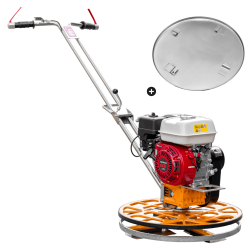
- Walk-Behind Combustion Power Trowels
-
-
-
Heating and cooling
-
Generators
-
Earthworks
-
Industrial vacuums
-
Finishing
-
Pumps
-
Measurement
-
BLOG & Tips
-
Promotions
Kategorie 16 kategorii
Kategorie
-
- Levels and Measurements
- Soil Compactors
- Tamping Rammers - Jumping Jacks
- Single Direction Vibratory Plates
- Reversible Vibratory Plates
- Rollers
- 100 kg Soil Compactors
- 200 kg Soil Compactors
- 300 kg Soil Compactors
- 400 kg Soil Compactors
- 500 kg Soil Compactors
- 600 kg Soil Compactors
- 700 kg Soil Compactors
- 800 kg Soil Compactors
- Wacker Neuson Compactors
- Accessories for Compactors
- Bomag Compactors
- Altrad Belle Compactors
- Paver Compactors
- Swepac Compactors
- Power Generators
- Concreting
- Concrete Vibrators
- Complete 230 V Mechanical Vibrators
- Vibrator Heads
- Vibrator Shafts
- Vibrator Motors
- Concrete Vibrators 42 V | 200 Hz
- Mechanical Vibrators 230 V
- 42 V | 200 Hz Head and Shaft
- 230 V Concrete Vibrators
- Vibrators With Built-In 230 V | 200 Hz Converter
- 42 V | 200 Hz Converters
- Combustion Vibrators
- Pneumatic Vibrators
- External Vibrators
- Vibratory Screeds
- Power Trowels
- Concrete Hand Tools
- Concrete Vibrators
- Pumps and Motor Pumps
- Cutting, Drilling and Grinding
- Heating and Cooling
- Wood Table Saws
- Painting and Plastering
- Combustion Engines
- Washing and Vacuuming
- Cement Mixers
- Paving Tools
- Wheelbarrows and Track Dumpers
- Demolition and Hammers
- Sales
- Levels and Measurements
Brak kategorii pasujących do wyszukiwania.
Cement Stirrers
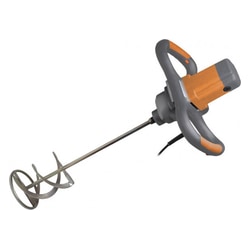
Altrad Belle Promix 1800E Electric Mixer
PROM18zł724.47 tax incl. 589,00 zł tax excl.View technical data Zobacz szczegóły
- Weight: 7,8 kg
- Engine power: 1,8 kW
- Max. amount of mixed material: 227 l
- Max. diameter of the agitator: 160 mm
Altrad Belle Promix 1600E Electric Mixer
PROM06zł779.82 tax incl. 634,00 zł tax excl.View technical data Zobacz szczegóły
- Weight: 7,8 kg
- Engine power: 1,6 kW
- Max. amount of mixed material: 227 l
- Max. diameter of the agitator: 160 mm
Mixer 2 Blades, 140 Mm For Altrad Belle PROMIX 1200E
949/99584zł147.60 tax incl. 120,00 zł tax excl.No technical data available Zobacz szczegóły
Mixer 2 Blades, 160 Mm For Altrad Belle PROMIX 1600E
949/99585zł147.60 tax incl. 120,00 zł tax excl.No technical data available Zobacz szczegóły
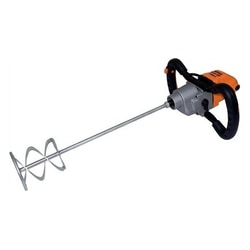
Altrad Belle Promix 1200E Electric Mixer
PROM05zł761.37 tax incl. 619,00 zł tax excl.View technical data Zobacz szczegóły
- Weight: 7,0 kg
- Engine power: 1,2 kW
- Max. amount of mixed material: 113 l
- Max. diameter of the agitator: 140 mm
ATIKA RL 1400 Altrad Belle Electric Mixer
319007zł404.67 tax incl. 329,00 zł tax excl.View technical data Zobacz szczegóły
- Weight: 5,2 kg
- Engine power: 1,35 kW
- Max. amount of mixed material: 65 l
- Max. diameter of the agitator: 140 mm
- Attachment of the agitator: M14
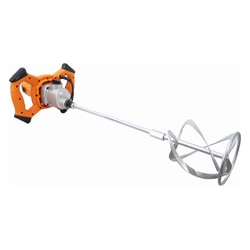
ATIKA RW 1800-2 PROFI Altrad Belle Electric Mixer
319004zł699.87 tax incl. 569,00 zł tax excl.View technical data Zobacz szczegóły
- Weight: 9,0 kg
- Engine power: 1,8 kW
- Max. amount of mixed material: 90 l
- Max. diameter of the agitator: 160 mm
- Attachment of the agitator: M14
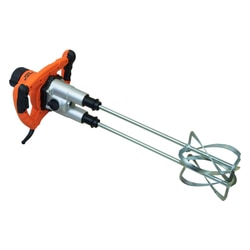
ATIKA RW 1800-2 TWIN Altrad Belle Electric Mixer
319008zł699.87 tax incl. 569,00 zł tax excl.View technical data Zobacz szczegóły
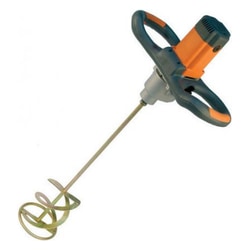
- Weight: 9,0 kg
- Engine power: 1,8 kW
- Max. amount of mixed material: 90 l
- Max. diameter of the agitator: 220 mm
- Attachment of the agitator: M14
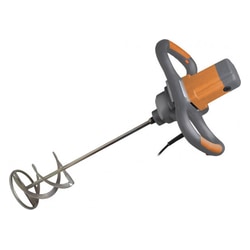
An electric mortar mixer is a hand-held machine that blends adhesives, renders, skim coats, plaster, self-levelling screeds and paints straight in the bucket or mixing tub. A 1.2–1.8 kW motor drives an interchangeable paddle of 140–160 mm on an M14 thread, so a batch reaches a uniform consistency within 1–3 minutes, free of lumps and without whipping air into the mix.
NORWIT.PL supplies professional stirrers from Altrad Belle — single-spindle Promix units for adhesives and mortars, plus ATIKA builds including a twin-spindle version running two counter-rotating paddles. Single batches range from roughly 65 to 227 litres, and tool weight from about 5.2 to 9.0 kg.
A hand mixer is meant for ready-mixed, bucket-scale materials — batching concrete with aggregate calls for free-fall cement mixers instead. Below we explain how to match motor power to the material and when a twin-spindle machine pays off.
Electric stirrer versus cement mixer — two different machines
An electric stirrer works inside whatever vessel the contractor already has: a 20–30 litre bucket, a bricklayer's tub or a container holding up to 227 litres. The 140–160 mm paddle lifts material from the bottom upwards while the operator manages speed through the motor electronics. That makes it a tool for fine-grained mixes — tile and insulation adhesive, skim coat, plaster, bagged mortar, levelling screed.
A cement mixer works the other way round, tumbling concrete with aggregate inside a rotating drum. No paddle copes with gravel, and no drum is any use for 20 litres of adhesive, so both run side by side on site — the stirrer travelling with the finishing crew alongside their other concrete hand tools.
Matching motor power to the material
Motor power sets two limits: how stiff a mix the machine handles without overheating, and how large a batch it turns over in one cycle. Machines here run from 1.2 to 1.8 kW, with batch capacity climbing from roughly 65 to 227 litres.
| Power class | Max. batch volume | Max. paddle diameter | Typical use |
|---|---|---|---|
| approx. 1.2 kW | up to approx. 65 l | 140 mm | tile and insulation adhesive, skim coats, paints, plaster |
| approx. 1.4 kW | up to approx. 110 l | 140 mm | light finishing work, tight interiors |
| approx. 1.6 kW | up to approx. 160 l | 160 mm | masonry and adhesive mortars, screeds, renders |
| approx. 1.8 kW | up to approx. 227 l | 160 mm; twin-spindle: two paddles | stiff mortars, resins, continuous crew work |
Weight is the second criterion, spanning about 5.2 to 9.0 kg. Over hours of skim-coat mixing every kilogram tells on the wrists, so finishing trades are better served by a machine around 1.2–1.4 kW, leaving 1.8 kW builds for stiff material.
Single-spindle or twin-spindle
A single-spindle stirrer carries one M14 shaft, takes paddles of 140–160 mm and covers most finishing jobs. A twin-spindle build drives two counter-rotating paddles, widening the mixing span and splitting the torque across two points. Material stops riding up the bucket wall and the machine tugs far less at the operator on start-up — the decisive argument with high-viscosity mixes. Drives of this class come from Altrad Belle, together with interchangeable 140 and 160 mm paddles.
Frequently asked questions
How much power does a stirrer need for adhesives and mortars?
Tile adhesive, skim coat and plaster are handled comfortably by a motor around 1.2–1.4 kW with a 140 mm paddle, which turns over a batch of roughly 65–110 litres. Masonry mortars, levelling screeds and stiff adhesives call for 1.6–1.8 kW and a 160 mm paddle, with batches reaching 227 litres. The rule is simple: the stiffer the mix and the wider the paddle, the more power you need. A motor running permanently at its limit heats up and shortens gearbox life, so professionals should buy a power class with headroom.
What makes an electric stirrer different from a drill with a mixing attachment?
A purpose-built stirrer runs a gearbox tuned for low speed and high torque, two handles that spread the load across both arms, and an M14 thread taking paddles of 140–160 mm. A drill spins in the range designed for boring holes, and its gearbox is not rated for minutes of continuous load on a batch of several dozen litres. For the odd bucket of adhesive a drill will do, but in daily professional use the windings overheat. A dedicated stirrer weighs about 5.2–9.0 kg, and that mass damps the kick when the paddle bites.
Which paddle suits which material?
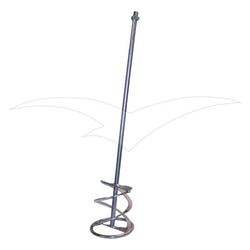
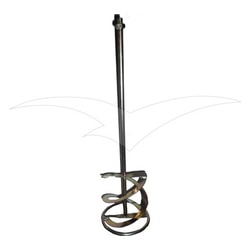
Paddle geometry governs which way the material flows. A 140 mm basket paddle mixes gently and introduces very little air, so it goes into paints, skim coats and fillers where bubbles are a defect. A downward-pumping helical paddle presses the mix towards the bottom of the vessel and copes better with adhesives and mortars. Diameter follows the vessel and the drive: 140 mm for 20–30 litre buckets and motors around 1.2 kW, 160 mm from 1.6 kW up, two paddles on twin-spindle machines. M14 is the standard fitting, so paddles swap freely between tools.
When does a hand stirrer stop being enough and a cement mixer take over?
Two things draw the line: aggregate in the mix, and batches per day. A hand stirrer manages portions up to 227 litres, but only of fine-grained material — adhesive, skim coat, plaster, mortar, screed. Concrete with gravel above a few millimetres tears at the paddle arms and overloads the gearbox, so it belongs in a 230 V cement mixer or a larger three-phase machine. Repetition is the second signal: at ten or more batches a day a drum mixer is faster, and the stirrer returns to finishing compounds.