


-
-
Concrete
-
- Concreting
- Concrete Vibrators
- Complete 230 V Mechanical Vibrators
- Vibrator Heads
- Vibrator Shafts
- Vibrator Motors
- Concrete Vibrators 42 V | 200 Hz
- Mechanical Vibrators 230 V
- 42 V | 200 Hz Head and Shaft
- 230 V Concrete Vibrators
- Vibrators With Built-In 230 V | 200 Hz Converter
- 42 V | 200 Hz Converters
- Combustion Vibrators
- Pneumatic Vibrators
- External Vibrators
- Power Trowels
- Vibratory Screeds
- Concrete Hand Tools
- Concrete Vibrators
-
-
-
-
-
- Walk-Behind Combustion Power Trowels
-
-
-
Heating and cooling
-
Generators
-
Earthworks
-
Industrial vacuums
-
Finishing
-
Pumps
-
Measurement
-
BLOG & Tips
-
Promotions
Kategorie 16 kategorii
Kategorie
-
- Levels and Measurements
- Soil Compactors
- Tamping Rammers - Jumping Jacks
- Single Direction Vibratory Plates
- Reversible Vibratory Plates
- Rollers
- 100 kg Soil Compactors
- 200 kg Soil Compactors
- 300 kg Soil Compactors
- 400 kg Soil Compactors
- 500 kg Soil Compactors
- 600 kg Soil Compactors
- 700 kg Soil Compactors
- 800 kg Soil Compactors
- Wacker Neuson Compactors
- Accessories for Compactors
- Bomag Compactors
- Altrad Belle Compactors
- Paver Compactors
- Swepac Compactors
- Power Generators
- Concreting
- Concrete Vibrators
- Complete 230 V Mechanical Vibrators
- Vibrator Heads
- Vibrator Shafts
- Vibrator Motors
- Concrete Vibrators 42 V | 200 Hz
- Mechanical Vibrators 230 V
- 42 V | 200 Hz Head and Shaft
- 230 V Concrete Vibrators
- Vibrators With Built-In 230 V | 200 Hz Converter
- 42 V | 200 Hz Converters
- Combustion Vibrators
- Pneumatic Vibrators
- External Vibrators
- Vibratory Screeds
- Power Trowels
- Concrete Hand Tools
- Concrete Vibrators
- Pumps and Motor Pumps
- Cutting, Drilling and Grinding
- Heating and Cooling
- Wood Table Saws
- Painting and Plastering
- Combustion Engines
- Washing and Vacuuming
- Cement Mixers
- Paving Tools
- Wheelbarrows and Track Dumpers
- Demolition and Hammers
- Sales
- Levels and Measurements
Brak kategorii pasujących do wyszukiwania.
Piston Paint Sprayers
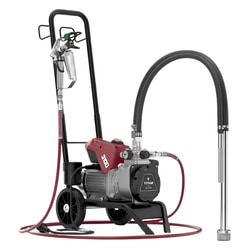
Generator Titan Compact 190 Paint Sprayer
2429263zł3,698.00 tax incl. 3 006,50 zł tax excl.View technical data Zobacz szczegóły
- Engine power: 0,56 kW
- Voltage: 230 V
- Engine: Elektryczny
- Max. pressure: 200 bar
- Hose length: 15 m
Generator Titan Elite 3100 Membrane Paint Sprayer
2432635zł8,998.00 tax incl. 7 315,45 zł tax excl.View technical data Zobacz szczegóły
- Weight: 27 kg
- Engine power: 1,3 kW
- Frequency: 50 Hz
- Voltage: 230 V
- Engine: Elektryczny
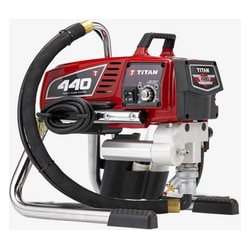
Generator Titan Impact 440 Paint Sprayer
0532035Azł9,373.01 tax incl. 7 620,33 zł tax excl.View technical data Zobacz szczegóły
- Engine power: 1,03 kW
- Voltage: 230 V
- Engine: Elektryczny
- Max. pressure: 223 bar
- Hose length: 15 m
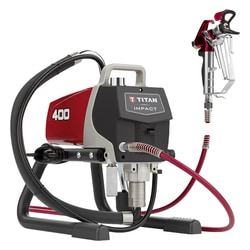
Generator Titan Impact 400 HEA Paint Unit
2413461zł7,054.00 tax incl. 5 734,96 zł tax excl.View technical data Zobacz szczegóły
- Engine power: 0,56 kW
- Voltage: 230 V
- Engine: Elektryczny
- Max. pressure: 207 bar
- Hose length: 15 m
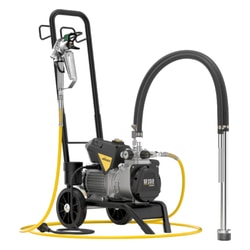
Generator Wagner Superfinish 23 PRO Paint Unit
2399198zł9,963.00 tax incl. 8 100,00 zł tax excl.View technical data Zobacz szczegóły
- Engine power: 1,3 kW
- Voltage: 230 V
- Engine: Elektryczny
- Max. pressure: 250 bar
- Hose length: 15 m
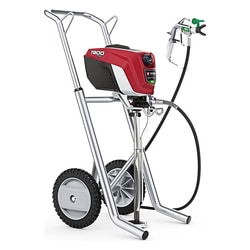
Generator Titan Control Max 1900 Pro Cart Paint Unit
2371081zł3,783.00 tax incl. 3 075,61 zł tax excl.View technical data Zobacz szczegóły
- Engine power: 0,6 kW
- Voltage: 230 V
- Engine: Elektryczny
- Max. pressure: 110 bar
- Hose length: 15 m
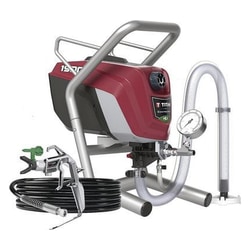
Generator Titan Control Max 1900 Pro Skid Paint Unit
2371077zł3,203.01 tax incl. 2 604,07 zł tax excl.View technical data Zobacz szczegóły
- Engine power: 0,6 kW
- Voltage: 230 V
- Engine: Elektryczny
- Max. pressure: 110 bar
- Hose length: 15 m
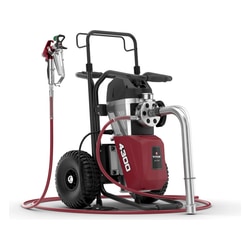
Generator Titan Elite 4300 Membrane Paint Sprayer
ELITE4300zł20,787.00 tax incl. 16 900,00 zł tax excl.View technical data Zobacz szczegóły
- Engine power: 2200 W
- Voltage: 230 V
- Engine: Elektryczny
- Producent: Titan
- Max. pressure: 250 bar
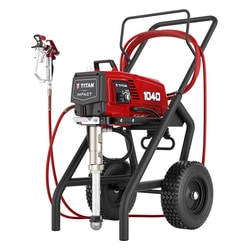
Generator Titan Impact 1040 Paint Sprayer
532033zł26,695.00 tax incl. 21 703,25 zł tax excl.View technical data Zobacz szczegóły
- Engine power: 2,0 kW
- Voltage: 230 V
- Engine: Elektryczny
- Max. pressure: 221 bar
- Hose length: 15 m
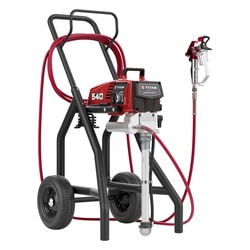
Generator Titan Impact 540 Paint Sprayer
532031zł16,148.01 tax incl. 13 128,46 zł tax excl.View technical data Zobacz szczegóły
- Engine power: 1,2 kW
- Voltage: 230 V
- Engine: Elektryczny
- Max. pressure: 228 bar
- Hose length: Brak danych
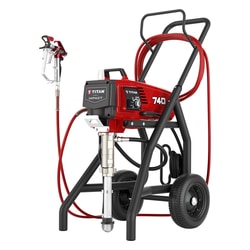
Generator Titan Impact 740 Paint Sprayer
532032zł19,497.00 tax incl. 15 851,22 zł tax excl.View technical data Zobacz szczegóły
- Engine power: 1,72 kW
- Voltage: 230 V
- Engine: Elektryczny
- Max. pressure: 227 bar
- Hose length: 15 m
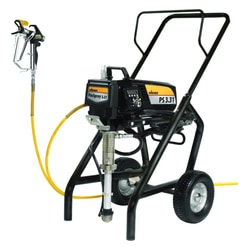
Generator Wagner Pro Spray 3.31 Paint Unit
2308262zł26,978.82 tax incl. 21 934,00 zł tax excl.View technical data Zobacz szczegóły
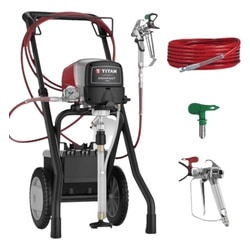
- Engine power: 1,8 kW
- Voltage: 230 V
- Engine: Elektryczny
- Max. pressure: 221 bar
- Hose length: 15 m
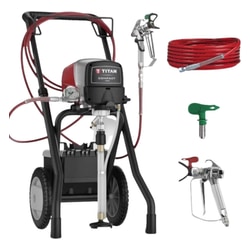
A piston paint sprayer is an airless machine in which a piston works directly in the coating and pressurises it mechanically. That layout reaches around 200–230 bar with an output usually between 2 and more than 8 l/min, so it keeps moving heavy materials — primers, façade paints, anti-corrosion coatings and high-viscosity compounds — that a diaphragm pump cannot sustain hour after hour.
At NORWIT.PL the piston range is built mainly around Titan and Wagner: cart-mounted units sized for flats and office interiors, through to heavy machines that feed two guns at once on site. Both makers have their own pages — Titan Wagner and Wagner. For water-based paints and lighter jobs, membrane paint sprayers are the alternative, and the full line-up sits in paint sprayers.
How a piston pump works
Inside a piston sprayer the motor drives a piston in a cylinder: it draws paint through the foot valve and forces it into the hose at roughly 200–230 bar; the tip then breaks that stream into a mist with no compressed air, which is why the method is called airless. With no diaphragm to flex, pressure holds steady even when the coating is thick or chilled to a few degrees.
Contractor-grade piston units deliver about 2 to over 8 l/min, which works out at 200–600 m² sprayed per hour, with reserve to run two guns from one pump. Piston packings, ball valves and filters are replaceable, so with regular flushing the machine works season after season.
Piston or membrane — how to decide
The deciding factors are the material and the length of the working day, not price: a piston pump suits dense coatings and long runs, while a membrane (diaphragm) unit is simpler to look after on water-based paint.
| Criterion | Piston sprayer | Membrane sprayer |
|---|---|---|
| Working pressure | usually 200–230 bar | usually up to approx. 200 bar |
| Output | approx. 2–8 l/min and up | approx. 2–4 l/min |
| Dense materials (primers, façade paints) | yes | limited |
| Continuous spraying for hours | yes | no |
| Two guns from one pump | stronger models only | no |
| Largest tip | usually 0.021–0.031" | usually up to 0.021" |
In short: façades, steel structures, industrial buildings and solvent-based coatings call for a piston machine, while interiors, latex paints and occasional use are covered by a membrane sprayer. Skim coats and jointing compounds are handled by heavy-duty spackling sprayers.
Matching tip and output to the material
Tip choice follows the viscosity of the coating, not the size of the wall. In a three-digit tip code the first digit doubled gives the fan width in inches from 30 cm, and the last two give the orifice in thousandths of an inch: 517 means roughly a 10" fan and a 0.017" orifice.
- Lacquers, stains, thin primers — tips 0.009–0.013", about 2 l/min is enough.
- Latex and acrylic interior paints — tips 0.015–0.019", consumption around 0.25 l per m².
- Façade, silicone and anti-corrosion paints — tips 0.021–0.027", pump from 4 l/min up.
- Coarse-textured compounds — tips from 0.027" up, 3/8" hose past 30 m.
Tips, filters and guns sit in paint sprayer accessories; road lines are laid with line stripers — the same pump on a wheeled frame.
FAQ — piston paint sprayers
When is a piston sprayer the better choice over a membrane one?
A piston machine earns its keep when the coating is dense and the working day is long. The piston running in a cylinder produces around 200–230 bar and 2 to more than 8 l/min, so it pushes primer, façade paint or anti-corrosion coating through a 0.027" tip for hours without losing pressure. A membrane pump tops out near 2–4 l/min on water-based paints, though it costs less to service.
What output should a piston sprayer have for façade work?
Façade spraying starts sensibly at a pump rated around 4 l/min driving a tip of at least 0.021". Silicone and silicate paints are thicker than interior latex, and output sets the pace: at 4 l/min a crew covers 200–300 m² per hour, at 8 l/min close to double that. Past 30 m of line, move from a 1/4" to a 3/8" hose so pressure loss does not starve the gun.
Will a piston sprayer cope with anti-corrosion systems and industrial lacquers?
Solvent-based coatings, including anti-corrosion systems and industrial lacquers, are a standard application for piston pumps, provided the seals and hose are rated for them — check the approved media on the data sheet. Flush with the same solvent used to thin the material, in a closed circuit for 5–10 minutes. Ventilation is mandatory and every ignition source has to be cleared from the area, because mist produced at 200 bar is flammable.
How should a piston pump be maintained after a day of spraying?
Maintenance is three steps at the end of every spraying day. Flush the circuit — water for water-based paints, solvent for the rest — until the gun runs clear, typically 5–10 minutes. Clean the pump filter, the gun filter and the tip, blowing it through from the outlet side. Finally add 5–10 ml of preservative oil to the cylinder to protect the piston packings. Skipped flushing is the most common cause of pressure loss and early valve replacement.