


-
-
Concrete
-
- Concreting
- Concrete Vibrators
- Complete 230 V Mechanical Vibrators
- Vibrator Heads
- Vibrator Shafts
- Vibrator Motors
- Concrete Vibrators 42 V | 200 Hz
- Mechanical Vibrators 230 V
- 42 V | 200 Hz Head and Shaft
- 230 V Concrete Vibrators
- Vibrators With Built-In 230 V | 200 Hz Converter
- 42 V | 200 Hz Converters
- Combustion Vibrators
- Pneumatic Vibrators
- External Vibrators
- Power Trowels
- Vibratory Screeds
- Concrete Hand Tools
- Concrete Vibrators
-
-
-
-
-
- Walk-Behind Combustion Power Trowels
-
-
-

Heating and cooling
-
Generators
-
Earthworks
-
Industrial vacuums
-
Finishing
-
Pumps
-
Measurement
-
BLOG & Tips
-
Promotions
Kategorie 16 kategorii
Kategorie
-
- Levels and Measurements
- Soil Compactors
- Tamping Rammers - Jumping Jacks
- Single Direction Vibratory Plates
- Reversible Vibratory Plates
- Rollers
- 100 kg Soil Compactors
- 200 kg Soil Compactors
- 300 kg Soil Compactors
- 400 kg Soil Compactors
- 500 kg Soil Compactors
- 600 kg Soil Compactors
- 700 kg Soil Compactors
- 800 kg Soil Compactors
- Wacker Neuson Compactors
- Accessories for Compactors
- Bomag Compactors
- Altrad Belle Compactors
- Paver Compactors
- Swepac Compactors
- Power Generators
- Concreting
- Concrete Vibrators
- Complete 230 V Mechanical Vibrators
- Vibrator Heads
- Vibrator Shafts
- Vibrator Motors
- Concrete Vibrators 42 V | 200 Hz
- Mechanical Vibrators 230 V
- 42 V | 200 Hz Head and Shaft
- 230 V Concrete Vibrators
- Vibrators With Built-In 230 V | 200 Hz Converter
- 42 V | 200 Hz Converters
- Combustion Vibrators
- Pneumatic Vibrators
- External Vibrators
- Vibratory Screeds
- Power Trowels
- Concrete Hand Tools
- Concrete Vibrators
- Pumps and Motor Pumps
- Cutting, Drilling and Grinding
- Heating and Cooling
- Wood Table Saws
- Painting and Plastering
- Combustion Engines
- Washing and Vacuuming
- Cement Mixers
- Paving Tools
- Wheelbarrows and Track Dumpers
- Demolition and Hammers
- Sales
- Levels and Measurements
Brak kategorii pasujących do wyszukiwania.
Rotating Laser Levels
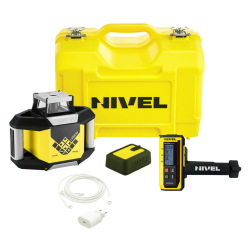
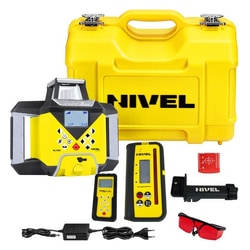
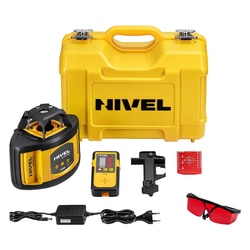
Laser Level Nivel System NL740R DIGITAL
NL740R DIGITALzł6,457.00 tax incl. 5 249,59 zł tax excl.View technical data Zobacz szczegóły
- Weight: 2,89 kg
- Dimensions: 274 x 173 x 232 mm
- Brand: Nivel System
- Power supply: Akumulator Li-ion 7,4 V 5000 mAh
- Operating temperature range: -10 °C do +50 °C
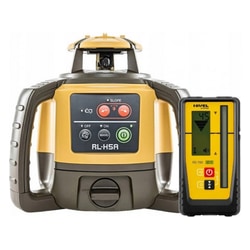
Topcon RL-H5A DIGITAL Self-Leveling Rotary Laser Level
RL-H5A DIGITALzł8,473.00 tax incl. 6 888,62 zł tax excl.View technical data Zobacz szczegóły
- Weight: 2,5 kg
- Dimensions: 211 x 172 x 205 mm
- Power supply: Akumulatorki ni-mh (w zestawie)
- Operating temperature range: -20 °C do +50 °C
- Leveling accuracy: ± 10” (0,5 mm / 10 m)
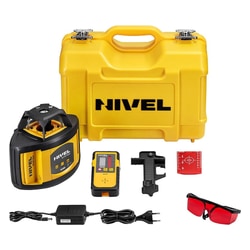
Laser Level Nivel System NL720R DIGITAL
NL720R DIGITALzł4,997.99 tax incl. 4 063,41 zł tax excl.View technical data Zobacz szczegóły
- Weight: 2,83 kg
- Dimensions: 274 x 173 x 232 mm
- Brand: Nivel System
- Power supply: Akumulator Li-ion 7,4 V 5000 mAh
- Operating temperature range: -10 °C do +50 °C
Nivel System NL540 Self-Levelling Rotary Laser Level
NL540zł4,489.50 tax incl. 3 650,00 zł tax excl.View technical data Zobacz szczegóły
- Weight: 3 kg
- Dimensions: 206 x 206 x 211 mm
- Brand: Nivel System
- Power supply: 7,4 V (Li-ion, 4000 mAh)
- Operating temperature range: -20 °C do +50 °C
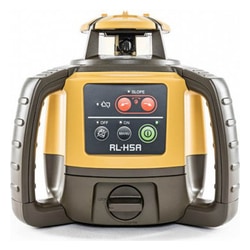
Topcon RL-H5A Self-Leveling Rotary Laser Level
RL-H5Azł7,366.47 tax incl. 5 989,00 zł tax excl.View technical data Zobacz szczegóły
- Weight: 2,5 kg
- Dimensions: 211 x 172 x 205 mm
- Brand: Nivel System
- Power supply: Akumulatorki ni-mh (w zestawie)
- Operating temperature range: -20 °C do +50 °C
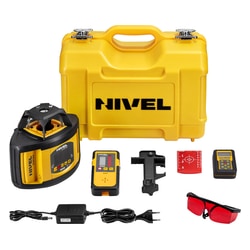
Rotary Laser Level Nivel System NL500
NL500zł3,328.38 tax incl. 2 706,00 zł tax excl.View technical data Zobacz szczegóły
- Weight: 3 kg
- Dimensions: 206 x 206 x 211 mm
- Brand: Nivel System
- Power supply: 7,4 V (Li-ion, 4000 mAh)
- Operating temperature range: -20 °C do +50 °C
Nivel System NL520 Self-Levelling Rotary Laser Level
NL520zł3,184.47 tax incl. 2 589,00 zł tax excl.View technical data Zobacz szczegóły
- Weight: 3 kg
- Dimensions: 206 x 206 x 211 mm
- Brand: Nivel System
- Power supply: Dc 8,4 V (1000ma), akumulatorki Li-ion 7,4 V (4000 mAh)
- Operating temperature range: -20 °C do +50 °C
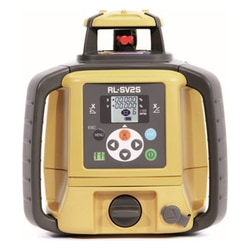
Topcon RL-SV2S DIGITAL Self-Leveling Rotary Laser Level
RL-SV2S DIGITALzł14,145.00 tax incl. 11 500,00 zł tax excl.View technical data Zobacz szczegóły
- Weight: 2,6 kg
- Dimensions: 196 x 177 x 217 mm
- Power supply: Akumulatorki ni-mh (w zestawie)
- Operating temperature range: -20 °C do +50 °C
- Leveling accuracy: ± 10” (2,4 mm / 50 m)
Nivel System NL520G Self-Leveling Rotary Laser Level
NL520Gzł3,998.73 tax incl. 3 251,00 zł tax excl.View technical data Zobacz szczegóły
- Weight: 3 kg
- Dimensions: 206 x 206 x 211 mm
- Brand: Nivel System
- Power supply: 7,4 V (Li-ion, 4000 mAh)
- Operating temperature range: -20 °C do +50 °C
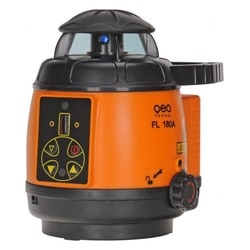
Geo-Fennel FL 180A Self-Leveling Rotary Laser Level
12-262-20zł2,650.65 tax incl. 2 155,00 zł tax excl.View technical data Zobacz szczegóły
- Weight: 1,7 kg
- Brand: Geo-Fennel
- Operating time - battery set: 40 h
- Operating range at temperature: -10 °C – +40 °C
- Instrument accuracy: ± 1,5 mm / 10 m
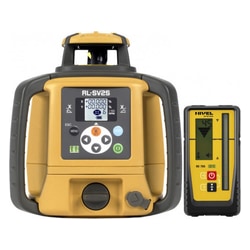
Topcon RL-SV2S Self-Leveling Rotary Laser Level
RL-SV2Szł12,177.00 tax incl. 9 900,00 zł tax excl.View technical data Zobacz szczegóły
- Weight: 2,6 kg
- Dimensions: 196 x 177 x 217 mm
- Power supply: Akumulatorki ni-mh (w zestawie)
- Operating temperature range: -20 °C do +50 °C
- Leveling accuracy: ± 10” (2,4 mm / 50 m)
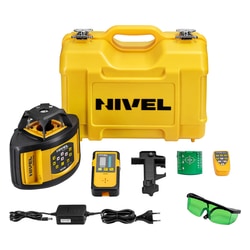
Laser Level Nivel System NL720G DIGITAL
NL720G DIGITALzł5,502.00 tax incl. 4 473,17 zł tax excl.View technical data Zobacz szczegóły
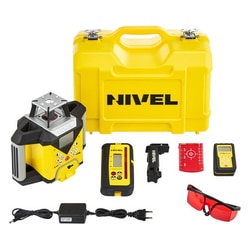
- Weight: 2,83 kg
- Dimensions: 274 x 173 x 232 mm
- Brand: Nivel System
- Power supply: Akumulator Li-ion 7,4 V 5000 mAh
- Operating temperature range: -10 °C do +50 °C
A rotary laser level (rotary laser) is a measuring instrument whose head spins through 360°, turning a point of light into a continuous reference plane — horizontal, vertical or tilted at a set angle (grade). A self-leveling compensator sets this plane automatically to an accuracy on the order of ±1 mm per 10 m, and a receiver on the staff picks up the beam invisible in sunlight, giving a working range of up to 600 m in diameter. This lets one operator control screeds, floors, foundations, road grades and site leveling across the whole construction site — without a second person at the staff, as with an optical level.
At NORWIT.PL we carry rotary laser levels primarily by Nivel System, Geo Fennel and Topcon — from red-beam models for indoor work to units with a detector and a long range for large outdoor surfaces. We split the range into rotary laser levels with grade for setting out road and drainage inclines and rotary laser levels without grade for level and plumb work; both categories belong to the laser levels department. Gear by Nivel System is available on the dedicated manufacturer page. Below we explain how a rotary laser works, how it differs from a line and an optical level, and how to match the model, receiver and tripod to the job.
Nivel System and Geo Fennel rotary laser levels — how a rotary laser works
A rotary laser level (rotary laser) is a tool in which a laser beam hits a spinning head. The point of light, driven at a speed typically of 300–600 rpm, turns into a continuous reference plane visible across the full 360°. This sets it apart from a line laser, which throws only static lines aimed forward.
Accuracy comes down to the compensator, a self-leveling mechanism. It automatically sets the plane in true level or plumb within a range typically of about ±5°, with a repeatability on the order of ±1 mm per 10 m in construction-grade models. When the tripod stands outside this range, the laser flags an error and switches the beam off, so it is not possible to work by accident on a false level. Beyond the range of sight — in sunlight or over a long distance — the plane is picked up by a receiver (a detector mounted on the staff), which indicates its position with sound and a display to an accuracy of about ±1 mm. At NORWIT.PL we carry rotary laser levels primarily by Nivel System and Geo Fennel, rounded out by Topcon survey-grade models. Below we show the difference between a grade and a non-grade variant, a run-through of popular models, and how to match range and detector to the job.
Types of rotary laser levels — with grade or without grade
The main selection criterion is whether the rotary laser can tilt the plane at a set angle. Rotary laser levels without grade hold the beam only level or plumb — simpler tools for screeds, floors and interior fit-out. Rotary laser levels with grade (the grade function) program a tilt in one or two axes, which is essential for drainage, driveways, roads and site grading.
| Feature | Without grade | With grade |
|---|---|---|
| Working plane | level and plumb only | level, plumb and tilt |
| Grade axes | none | single- or dual-axis (X, Y) |
| Grade range | – | typically about ±5–10% |
| Use | screeds, floors, ceilings, formwork | drainage, driveways, roads, ramps |
| Best for | finishing crews, floor layers | road crews, paving crews, drainage installers |
The tilt value (e.g. 1.5% to drain water away) is entered digitally from the control panel, separately for the X and Y axis. Models with grade also perform every task available in true level — it is an added function, not a separate class of equipment.
Popular rotary laser level models at NORWIT.PL
Below is a cross-section of the range, from red-beam models to green units with higher visibility. Exact parameters are on the product pages.
| Model | Beam | Typical use |
|---|---|---|
| Nivel System NL720R DIGITAL | red | screeds, floors, indoor work |
| Nivel System NL720G DIGITAL | green | better visibility in bright interiors |
| Nivel System NL740R DIGITAL | red | larger sites, work with a detector |
| Nivel System NL740G DIGITAL green | green | large surfaces, high visibility |
| geo-FENNEL EL 515 Plus self-leveling | red | general construction work, screeds |
Pair your rotary laser level with a matching receiver (detector) — mandatory outdoors and at long range — and a tripod and levelling staff with a 5/8" thread, which turn the laser plane into a height reading. If you only need a line for indoor fit-out rather than a 360° plane, check out cross-line lasers.
Range, detector and matching a Nivel System or Geo Fennel rotary laser to the job
The range of construction-grade Nivel System and Geo Fennel rotary laser levels is given as the working diameter with a receiver, and it typically runs to 300–600 m, while the naked eye picks up the beam only up to about 20–50 m indoors. Outdoors a receiver (a detector on the staff) is therefore essential, because in daylight both the red and the green beam become invisible. It is worth matching the enclosure's ingress protection class (IP, resistance to dust and water) to at least IP54, and on demanding sites — IP65 or higher.
| Use | Working environment | What to check |
|---|---|---|
| Screeds and floors | indoor | accuracy about ±1 mm/10 m, staff, optional detector |
| Ceilings, fitting installations | indoor | green beam — visible without a detector |
| Foundations, façades | outdoor, shaded | detector, range 300–400 m |
| Sites, large surfaces, halls | outdoor, full sun | detector mandatory, range 400–600 m, IP54–IP66 |
| Roads, driveways, drainage | outdoor | single- or dual-axis grade function |
Indoors, over a short distance of up to about 20–50 m and in good light, a rotary laser also works without a receiver — especially a green-beam model, which reads more clearly than a red one. In larger, brighter halls a detector still speeds up reading the plane.
Rotary vs line and optical laser levels — the differences
A rotary laser level draws a spinning 360° plane with a range of 300–600 m with a detector and is operated by one person. A line (cross-line) laser level throws static lines at a 90° angle, visible typically up to 20–40 m, and suits fitting installations or tiling — it is cheaper but cannot cover a whole site with a single plane. The choice depends on scale: rotary for large, open surfaces, line for indoor work at short range.
An optical level (a sighting telescope with a staff, operated by two people) remains the most accurate tool in precision surveying — reaching up to about ±1 mm per 1 km. A rotary laser level does not fully replace it for that work, but in everyday construction — screeds, foundations, grades and site leveling — it is faster, because it self-levels and covers a 360° plane in a single setup, without a second person at the staff.
Frequently asked questions about rotary laser levels
What is the difference between a rotary laser level with grade and one without grade?
A rotary laser level without grade holds the plane only level or plumb — a simpler, cheaper tool for screeds, floors and ceiling work. A model with grade (the grade function) additionally tilts the plane at a set angle in one or two axes, setting out inclines of roughly 1–2% for drainage, driveways and roads. You dial the grade in digitally from the control panel, separately for the X and Y axis, and a grade-enabled unit still performs every task available in the base version.
How does a rotary laser level work?
A laser beam hits a head that spins at 300–600 rpm, turning the point of light into a continuous plane visible across the full 360°. A self-leveling compensator sets it level or plumb to an accuracy on the order of ±1 mm per 10 m, within a range of about ±5°. Beyond the range of sight — in sunlight, for example — a receiver on the staff picks up the plane, signalling its position with sound and a display.
What range do Nivel System and Geo Fennel rotary laser levels have?
Nivel System and Geo Fennel rotary laser levels typically work over a range of 300–600 m in diameter with a receiver, while the naked eye picks up the beam only up to about 20–50 m indoors. Range depends on the model and beam colour — the NL740 series covers larger sites than the compact NL720. On open, sunlit surfaces the real range is set mainly by the quality of the receiver.
Does a rotary laser level need a separate laser receiver?
Outdoors a receiver (detector) is practically essential, because in daylight both a red and often a green beam become invisible beyond a dozen or so metres. Mounted on the staff, the receiver picks up the plane to an accuracy of about ±1 mm and signals its position with sound and a display. Indoors, over a short distance of up to about 20–30 m in good light, some work can be done without a detector using a green-beam laser.
How much does a rotary laser level for construction cost?
Prices for construction-grade rotary laser levels start at around PLN 1,500–2,500 for basic red-beam models without a grade function. Extended kits with a green beam, a detector and single- or dual-axis grade typically cost PLN 4,000–8,000 and up. Price is driven by beam colour, range, accuracy (about ±1 mm per 10 m) and whether a tripod and staff are included. Current prices are on the product pages.
What is the difference between a rotary and a line (cross-line) laser level?
A rotary laser level has a spinning head and draws a full 360° plane, covering a site or hall up to about 300–600 m in diameter with a detector. A line (cross-line) laser level casts static lines at a 90° angle, visible typically up to 20–40 m, mainly indoors. Rotary wins on large, open surfaces and with grades; line wins for quick fit-out and finishing work.
Is a rotary laser level suitable for indoor work?
A rotary laser level also works well indoors — over a distance of up to about 20–50 m, and in good light the beam is visible to the naked eye, especially in the green version, about 4 times brighter to the eye than red. In larger, brighter halls a detector still speeds up reading the plane. For simple fit-out over a short distance, a cheaper line (cross-line) laser level works just as well.
How do you set the grade on a rotary laser level with the grade function?
Grade is set digitally from the control panel or a remote — you enter the tilt value as a percentage, for example 1.5% to drain water away, separately for the X and Y axis. Electronics correct the head angle during operation, holding the grade with a repeatability on the order of ±1 mm per 10 m. The adjustment range on typical models usually reaches about ±5–10%, covering most road and drainage grades.
Does a rotary laser level replace a traditional optical survey level?
A rotary laser level does not fully replace an optical level in precision surveying, where a telescope with a staff reaches an accuracy of up to ±1 mm per 1 km. In everyday construction work — screeds, foundations, grades and site leveling — it is faster, though, because it self-levels, covers a 360° plane with a single setup, and needs no second person at the staff.
What tripod and levelling staff fit a rotary laser level?
Rotary laser levels mount on a surveying tripod with a 5/8" thread — aluminium or wooden, with a working height on the order of 1.0–1.7 m. Reading is aided by a levelling staff typically 3–5 m long, matched by scale to the beam colour and receiver type. You'll find a tripod, staff and compatible detector for Nivel System and Geo Fennel models among the rotary laser level accessories.
Why buy a rotary laser level at NORWIT.PL
We focus on professional measurement: our range holds self-leveling rotary laser levels primarily by Nivel System and Geo Fennel, rounded out by Topcon survey-grade models — with a red and a green beam, in variants with grade and without grade. We advise on the range, beam colour and grade function for your specific job, and you can complete the set with receivers and detectors and tripods and staffs. The whole category belongs to the laser levels department. Orders ship online nationwide.