


-
-
Concrete
-
- Concreting
- Concrete Vibrators
- Complete 230 V Mechanical Vibrators
- Vibrator Heads
- Vibrator Shafts
- Vibrator Motors
- Concrete Vibrators 42 V | 200 Hz
- Mechanical Vibrators 230 V
- 42 V | 200 Hz Head and Shaft
- 230 V Concrete Vibrators
- Vibrators With Built-In 230 V | 200 Hz Converter
- 42 V | 200 Hz Converters
- Combustion Vibrators
- Pneumatic Vibrators
- External Vibrators
- Power Trowels
- Vibratory Screeds
- Concrete Hand Tools
- Concrete Vibrators
-
-
-
-
-
- Walk-Behind Combustion Power Trowels
-
-
-
Heating and cooling
-
Generators
-
Earthworks
-
Industrial vacuums
-
Finishing
-
Pumps
-
Measurement
-
BLOG & Tips
-
Promotions
Kategorie 16 kategorii
Kategorie
-
- Levels and Measurements
- Soil Compactors
- Tamping Rammers - Jumping Jacks
- Single Direction Vibratory Plates
- Reversible Vibratory Plates
- Rollers
- 100 kg Soil Compactors
- 200 kg Soil Compactors
- 300 kg Soil Compactors
- 400 kg Soil Compactors
- 500 kg Soil Compactors
- 600 kg Soil Compactors
- 700 kg Soil Compactors
- 800 kg Soil Compactors
- Wacker Neuson Compactors
- Accessories for Compactors
- Bomag Compactors
- Altrad Belle Compactors
- Paver Compactors
- Swepac Compactors
- Power Generators
- Concreting
- Concrete Vibrators
- Complete 230 V Mechanical Vibrators
- Vibrator Heads
- Vibrator Shafts
- Vibrator Motors
- Concrete Vibrators 42 V | 200 Hz
- Mechanical Vibrators 230 V
- 42 V | 200 Hz Head and Shaft
- 230 V Concrete Vibrators
- Vibrators With Built-In 230 V | 200 Hz Converter
- 42 V | 200 Hz Converters
- Combustion Vibrators
- Pneumatic Vibrators
- External Vibrators
- Vibratory Screeds
- Power Trowels
- Concrete Hand Tools
- Concrete Vibrators
- Pumps and Motor Pumps
- Cutting, Drilling and Grinding
- Heating and Cooling
- Wood Table Saws
- Painting and Plastering
- Combustion Engines
- Washing and Vacuuming
- Cement Mixers
- Paving Tools
- Wheelbarrows and Track Dumpers
- Demolition and Hammers
- Sales
- Levels and Measurements
Brak kategorii pasujących do wyszukiwania.
SoffCut 24h Floor Saws
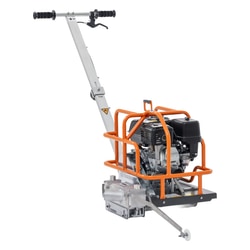
Toolsa TAS 150 Green Concrete Floor Saw (Honda GX 160)
TAS150zł8,608.77 tax incl. 6 999,00 zł tax excl.View technical data Zobacz szczegóły
- Weight: 38,5 kg
- Dimensions: 860 × 560 × 566 mm
- Engine power: 3,6 kW | 4,8 KM
- Min. distance from the wall: 76 mm
- Connecting a vacuum cleaner: 50 mm
Przecinarka do świeżego betonu Husqvarna Soff-Cut 150
966844821zł10,920.53 tax incl. 8 878,48 zł tax excl.View technical data Zobacz szczegóły
- Weight: 38,5 kg
- Fuel: Petrol
- Starter: Ręczny
- Output power: 3,6 kW
- Cylindry: 1
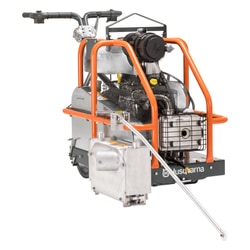
Przecinarka do świeżego betonu Husqvarna Soff-Cut 4000
966845506zł57,681.99 tax incl. 46 895,93 zł tax excl.View technical data Zobacz szczegóły
- Weight: 206 kg
- Fuel: Petrol
- Starter: Elektryczny
- Output power: 15,3 kW
- Cylindry: 2
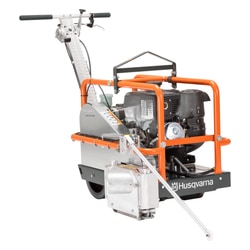
Przecinarka do świeżego betonu Husqvarna Soff-Cut 2000
966845304zł54,735.00 tax incl. 44 500,00 zł tax excl.View technical data Zobacz szczegóły
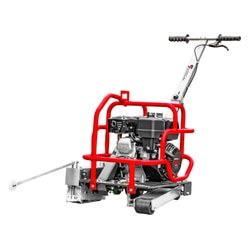
- Weight: 150 kg
- Fuel: Petrol
- Starter: Elektryczny
- Output power: 7,1 kW
- Cylindry: 1
An early-entry floor saw built on Soff-Cut technology cuts the slab long before the concrete reaches full strength — typically 1–2 hours after trowelling rather than the next day. The machine runs dry, so there is no water and no slurry to wash off, and a skid plate riding on the surface guides the blade so the edge of the kerf holds together in concrete that is still green. A cut roughly 25–40 mm deep, made inside that window, takes over the shrinkage stresses and steers cracking into the joint the contractor planned instead of somewhere random in the floor.
This category covers equipment for early-entry shrinkage joints — mainly Husqvarna Construction, with Toolsa alongside it. Machines for cured concrete sit in the parent category, floor saws. Below we cover the cutting window, joint spacing and depth, and how the method differs from wet cutting.
Soff-Cut technology — cutting green concrete 1–2 h after trowelling
Soff-Cut is the early-entry method: the shrinkage joint is sawn while the concrete is still green, usually 1–2 hours after trowelling, not after a full day of curing. The saw works dry — no water, no slurry, no washing down afterwards. What makes it possible is the skid plate wrapped around the blade; it holds the aggregate down along the kerf, so soft concrete does not ravel at the edge.
The result is a narrow joint, normally 25–40 mm deep, made before shrinkage opens a crack of its own. Wet sawing means waiting most of a day until the slab is hard enough for the blade to stop tearing aggregate out — and random cracks often appear first.
The range here is built mainly around Husqvarna Construction, with Toolsa alongside. Cured concrete calls for walk-behind floor saws or self-propelled floor saws; the matching consumable is a fresh concrete diamond blade.
Early entry versus wet cutting
Both methods produce the same shrinkage joint; what differs is where in curing the cut happens.
| Criterion | Soff-Cut (early entry) | Wet cutting |
|---|---|---|
| When you cut | approx. 1–2 h after trowelling, green concrete | many hours later, on cured concrete |
| Water | none, dry cutting with extraction | cools the blade, produces slurry |
| Joint depth | usually 25–40 mm | approx. 1/4 of slab thickness, 40–80 mm |
| Kerf edge | held by skid plate, narrow and clean | unsupported, prone to ravelling |
| Risk of shrinkage cracks | low, the cut gets ahead of shrinkage | grows with every hour of delay |
| Typical use | industrial floors, warehouses, yards | mature pavements, refurbishment |
Spacing and depth of shrinkage joints
A saw cut is a deliberate weak line in the section: the slab cracks where the contractor decided. The rule of thumb for spacing is 24 to 36 times slab thickness, with panels kept near square — past a 1.5:1 side ratio, diagonal cracking becomes likely.
| Slab thickness | Indicative spacing | Cut depth |
|---|---|---|
| 10 cm | approx. 2.5–3.5 m | approx. 25 mm |
| 15 cm | approx. 3.5–5.0 m | approx. 30 mm |
| 20 cm | approx. 5.0–6.0 m | approx. 35–40 mm |
Early-entry concrete saws — questions
When can green concrete be cut with a Soff-Cut saw?
The early-entry window normally opens 1–2 hours after trowelling, once the slab carries the operator and the machine while the concrete is still green. One check settles it on site: if the kerf edge pulls aggregate out, you are too early. Heat shortens the window to 45–60 minutes around 30 °C, while at 10 °C it can stretch past 3 hours, so the schedule follows the weather, not the clock.
Why does the category name mention 24 h if cutting happens after 1–2 hours?
The "24h" label refers to the first day of curing — the only period in which shrinkage cracking can still be prevented — not to a 24-hour wait before sawing. Soff-Cut technology lets crews onto the slab early, typically 1–2 h after trowelling, where a wet saw would still have most of a day to wait. Every hour of delay raises the chance a crack forms outside the planned joint line.
What does the skid plate do, and why does the blade rotate upwards?
The skid plate slides along the slab beside the blade and presses the concrete down on both sides of a kerf typically 2–3 mm wide. Soft aggregate stays put at the edge and the joint comes out straight. On early-entry machines the blade turns upwards, unlike a wet saw, so cutting forces push the plate onto the floor instead of lifting it. The plate is a wear part, matched to blade diameter and cut depth of 25–40 mm.
Does dry cutting require dust extraction?
Working without water releases respirable crystalline silica, so early-entry saws are paired with an industrial vacuum using an H- or M-class filter and a hose of roughly 50–70 mm diameter. Extraction cuts operator exposure and keeps the cut line visible, so a string line is easy to follow. Hearing protection belongs on the list too, at noise around 100 dB. The upside of the method stays intact: no slurry, so the floor needs no washing down.