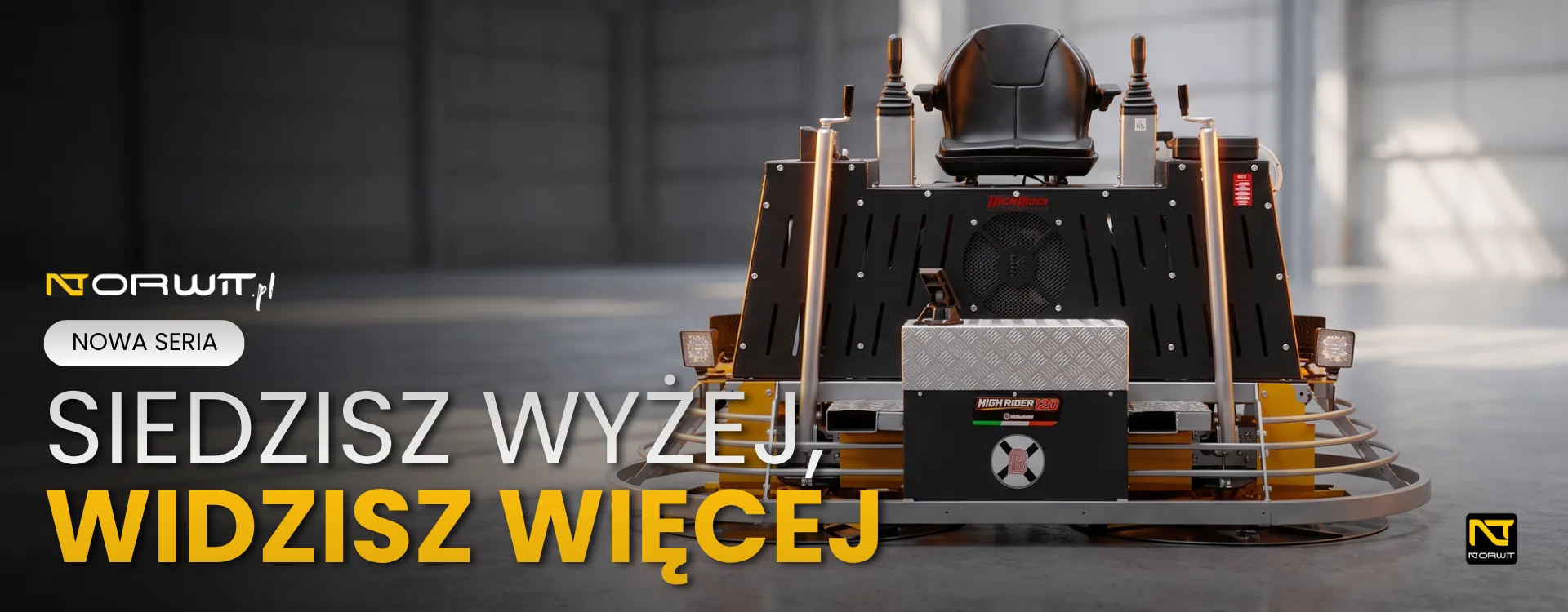
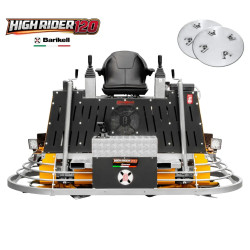
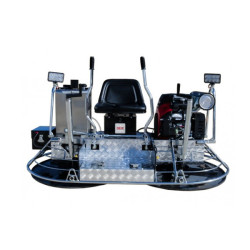
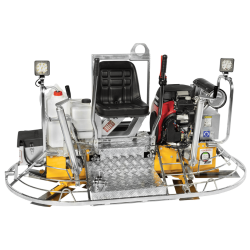
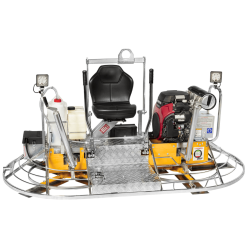
Barikell High Rider — new ride-on power trowel series with a raised seat (90 and 120)

Remigiusz Prędki 4 min czytania Aktualizacja 27.07.2026
Remigiusz Prędki Remigiusz PrędkiPresident of the Board 4 min 27.07.2026
W skrócie: High Rider is a new series of Barikell ride-on power trowels with a raised seat (112 cm on the 90, 122 cm on the 120) that gives the operator a full view of the slab being finished. The 90 runs a Briggs & Stratton 35 HP engine (2×900 mm discs); the 120 uses a liquid-cooled 57 HP Kubota (2×1200 mm, approx. 2.4 m pass) for large-area industrial floors.

Najczęstsze pytania

What is a High Rider power trowel and what does the raised structure give?

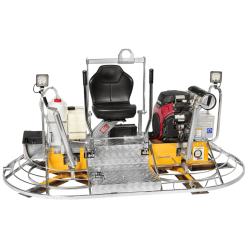
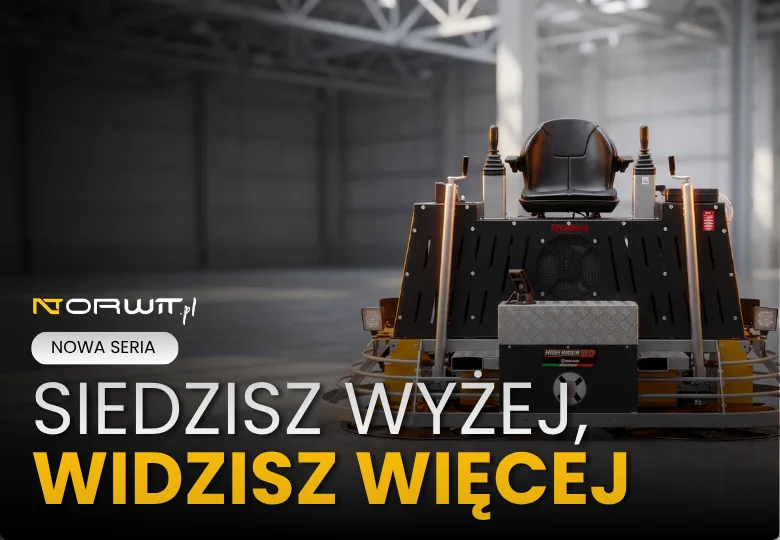
High Rider is a series of Barikell ride-on power trowels in which the operator sits higher than on classic machines — 112 cm on the 90 model and 122 cm on the 120. The higher position gives a full view of the slab, edges and obstacles, making it easier to control the sheen and steer the rotors across a large floor.

How do the High Rider 90 and 120 models differ?

The 90 works with 2×900 mm discs and an air-cooled Briggs & Stratton 35 HP engine, while the 120 uses 2×1200 mm discs and a liquid-cooled 57 HP Kubota. In one run the 90 finishes about a 1.8 m pass and the 120 about 2.4 m. Both have hydraulic steering and 148 rpm; the 120 also has LED lights.

What engine do High Rider trowels have?

The 90 model runs an air-cooled Briggs & Stratton rated 35 HP (25.7 kW), and the 120 a liquid-cooled 57 HP (42 kW) Kubota fuelled by 95 unleaded petrol. Both engines have electric start. Liquid cooling on the 120 matters for continuous work under full load.

How large an area does a ride-on trowel finish in one run?

With two non-overlapping discs, the High Rider finishes a pass of 1.8 m (90 model, 900 mm discs) up to 2.4 m (120 model, 1200 mm discs) in one run. That is roughly twice as wide as a typical single-disc walk-behind trowel, which is why ride-ons are used on areas measured in hundreds and thousands of square metres.

When should you choose a ride-on trowel over a walk-behind?

A ride-on is chosen for large industrial floors: halls, warehouses, car parks and logistics centres, where output and evenness over hundreds or thousands of m² matter. A walk-behind (single-disc) trowel remains better for small areas, narrow rooms and edge work.

When to start troweling and what tooling to use?

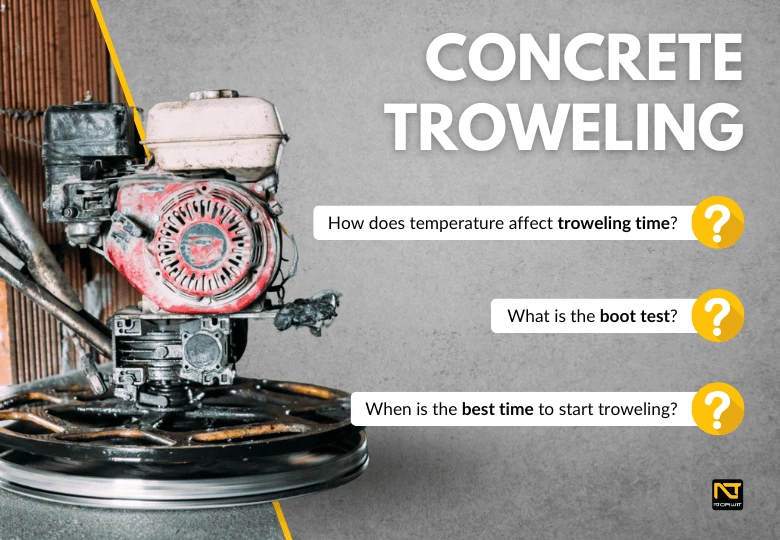
Troweling begins once the bleed water has evaporated and the concrete bears the weight of the machine and operator — usually a few hours after the pour, depending on temperature and humidity. You first use floating discs (pans) for initial smoothing, then achieve the final sheen with combination blades set at an increasing angle.

What sites is the High Rider 120 suited to?

The 120 model is designed for large-area industrial floors: production and storage halls, car parks, logistics centres and big pours. With 2×1200 mm discs and 57 HP it keeps up high output where single-disc trowels or smaller ride-ons would be too slow.
Blog navigation

O autorze

Remigiusz Prędki
Remigiusz Prędki
President of the Board
Remigiusz Prędki has spent over 25 years in concrete technology. Power trowels, vibrating screeds, grinders and milling machines are his home turf — that is where his know-how runs deepest. As President of the Board at NORWIT.PL, he advises contractors daily and shares hands-on, job-site knowledge.

Cookies

Cookie information

This website uses its own cookies to ensure you have the best possible experience on our site. We also use third-party cookies to enhance our services, analyze usage, and display ads tailored to your preferences based on your browsing behavior. 

Here you can learn more about how Google processes personal data.


For more information, please refer to our Privacy Policy.

Cookie management

About Cookies

Cookies are small text files that are stored on your computer or mobile device by websites you visit. They serve various purposes, such as remembering user login information, tracking user behavior for advertising purposes, and personalizing the user's browsing experience. There are two types of cookies: session and persistent. The former are deleted after the browser session ends, while the latter remain on the device for a specified period or until manually deleted.