


-
-
Concrete
-
- Concreting
- Concrete Vibrators
- Complete 230 V Mechanical Vibrators
- Vibrator Heads
- Vibrator Shafts
- Vibrator Motors
- Concrete Vibrators 42 V | 200 Hz
- Mechanical Vibrators 230 V
- 42 V | 200 Hz Head and Shaft
- 230 V Concrete Vibrators
- Vibrators With Built-In 230 V | 200 Hz Converter
- 42 V | 200 Hz Converters
- Combustion Vibrators
- Pneumatic Vibrators
- External Vibrators
- Power Trowels
- Vibratory Screeds
- Concrete Hand Tools
- Concrete Vibrators
-
-
-
-
-
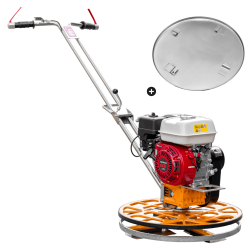
- Walk-Behind Combustion Power Trowels
-
-
-
Heating and cooling
-
Generators
-
Earthworks
-
Industrial vacuums
-
Finishing
-
Pumps
-
Measurement
-
BLOG & Tips
-
Promotions
Kategorie 16 kategorii
Kategorie
-
- Levels and Measurements
- Soil Compactors
- Tamping Rammers - Jumping Jacks
- Single Direction Vibratory Plates
- Reversible Vibratory Plates
- Rollers
- 100 kg Soil Compactors
- 200 kg Soil Compactors
- 300 kg Soil Compactors
- 400 kg Soil Compactors
- 500 kg Soil Compactors
- 600 kg Soil Compactors
- 700 kg Soil Compactors
- 800 kg Soil Compactors
- Wacker Neuson Compactors
- Accessories for Compactors
- Bomag Compactors
- Altrad Belle Compactors
- Paver Compactors
- Swepac Compactors
- Power Generators
- Concreting
- Concrete Vibrators
- Complete 230 V Mechanical Vibrators
- Vibrator Heads
- Vibrator Shafts
- Vibrator Motors
- Concrete Vibrators 42 V | 200 Hz
- Mechanical Vibrators 230 V
- 42 V | 200 Hz Head and Shaft
- 230 V Concrete Vibrators
- Vibrators With Built-In 230 V | 200 Hz Converter
- 42 V | 200 Hz Converters
- Combustion Vibrators
- Pneumatic Vibrators
- External Vibrators
- Vibratory Screeds
- Power Trowels
- Concrete Hand Tools
- Concrete Vibrators
- Pumps and Motor Pumps
- Cutting, Drilling and Grinding
- Heating and Cooling
- Wood Table Saws
- Painting and Plastering
- Combustion Engines
- Washing and Vacuuming
- Cement Mixers
- Paving Tools
- Wheelbarrows and Track Dumpers
- Demolition and Hammers
- Sales
- Levels and Measurements
Brak kategorii pasujących do wyszukiwania.
Line Stripers
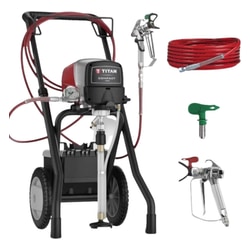
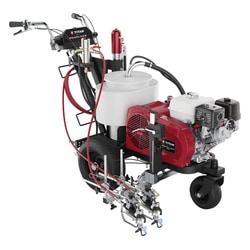
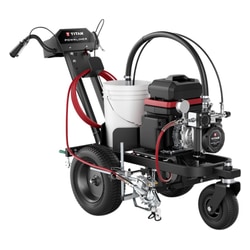
Titan POWRLINER 8955 Road Marking Painter
0290054Hzł54,842.99 tax incl. 44 587,80 zł tax excl.View technical data Zobacz szczegóły
- Engine power: 4,2 kW
- Voltage: Nie dotyczy
- Engine: Honda GX 200 el
- Max. pressure: 228 bar
- Hose length: 15 m
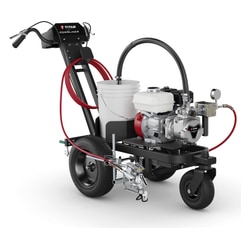
Titan POWRLINER 3500 1 Gun Road Marking Painter
0537015zł31,440.41 tax incl. 25 561,31 zł tax excl.View technical data Zobacz szczegóły
- Engine power: 2,98 kW
- Voltage: Nie dotyczy
- Engine: Honda GX 120
- Max. pressure: 228 bar
- Hose length: 15 m
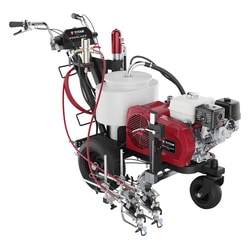
Titan POWRLINER 4955 Road Marking Painter
0290052Hzł51,376.01 tax incl. 41 769,11 zł tax excl.View technical data Zobacz szczegóły
- Engine power: 4,2 kW
- Voltage: Nie dotyczy
- Engine: Honda GX 120
- Max. pressure: 228 bar
- Hose length: 15 m
Titan POWRLINER 6955 Road Marking Painter
0290053Hzł52,878.00 tax incl. 42 990,24 zł tax excl.View technical data Zobacz szczegóły
- Engine power: 4,2 kW
- Voltage: Nie dotyczy
- Engine: Honda GX 160
- Max. pressure: 228 bar
- Hose length: 15 m
Titan POWRLINER 3500 (72 V) Battery-Powered Road Line Striper
2445730Bzł130,257.00 tax incl. 105 900,00 zł tax excl.View technical data Zobacz szczegóły
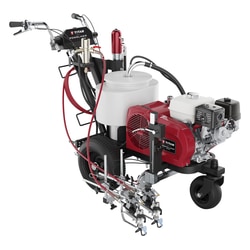
- Weight: 90,7 kg
- Voltage: 72 V
- Engine: Honda eGX 72 V
- Max. pressure: 228 bar
- Hose length: 15 m
A line striper is an airless spray unit built onto a wheeled trolley and designed for road marking: lane lines, pedestrian crossings, parking bays, aisles inside warehouse buildings and traffic routes on yards. An airless pump drives road paint at roughly 150–230 bar through a gun clamped above the surface, so the machine lays a stripe of constant width — usually 5–30 cm — while the operator simply walks.
NORWIT.PL supplies road marking machines mainly from Titan Wagner — the POWRLINER series, in push-along and self-propelled versions, for solvent-borne and water-based paints. Buyers are marking contractors, car park managers, road maintenance crews and industrial plants. If your job is walls, façades or ceilings instead, the right section is paint sprayers, while tips, filters and hoses sit under paint sprayer accessories. Below we explain how to match a striper to line width, paint type and the scale of the work ahead.
Line striper — how it differs from a wall sprayer
A line striper — also called a line marking trolley — relies on the same airless spraying principle as a paint sprayer, but every part of the frame is built around one job: pulling a straight, even stripe along the ground. Nobody holds the gun — it is clamped on an arm 5–15 cm above asphalt or concrete, and the operator steers along a sight guide. What comes out is a band of repeatable width and film thickness over hundreds of metres.
The second difference is material tolerance. Road paints are thick, loaded with chalk and pigment, and are usually applied together with glass beads that give the marking its retroreflectivity. Pumps in stripers therefore use seals rated for abrasive media, and tanks hold something like 20–100 litres so refill breaks stay rare. Machines from the paint sprayers section are not designed for that kind of load.
Types of road marking machines
The choice comes down to how many running metres of line you paint per season, and whether you work on a car park, inside a building or on a public road.
| Machine type | Drive and handling | Typical workload | Who buys it |
|---|---|---|---|
| Push-along striper | trolley pushed by hand, petrol or electric pump | up to a few thousand running metres a year | car parks, warehouse floors, yards, sports facilities |
| Self-propelled striper | driven wheels, steady walking speed held automatically | long continuous runs, several hours of work a day | marking contractors, road maintenance crews |
| Ride-on striper | operator rides the machine, 2 guns plus a bead dispenser | public roads, large contracts | specialised road marking companies |
The POWRLINER stripers from Titan cover the push-along and self-propelled versions — with an airless pump, a sight guide and an arm that lets you mark on the right or the left of the machine. Two-gun models produce a double line in a single pass.
Line width, paint and surface preparation
Line width follows from tip size and from how high the gun sits above the ground. In road marking, centre and edge lines are normally 12 cm wide, parking bay outlines 10–12 cm, and internal traffic aisles 5–10 cm. Paint cures only on a dry, swept substrate, above 5–10°C and below 80% relative humidity; fresh asphalt has to weather first. After each job the fluid section needs flushing with the matching solvent, and the filter and tip need cleaning — skipped flushing is the single most common reason for a pressure drop. Replacement tips, filters and hoses are listed under paint sprayer accessories.
Frequently asked questions about line stripers
How does a line striper differ from an airless sprayer used on walls?
A line striper is an airless unit mounted on a wheeled trolley, with the gun held on an arm 5–15 cm above the surface and a sight guide for steering. It reproduces a band of constant width, usually 5–30 cm, over hundreds of metres. A wall sprayer is hand-held and covers surfaces at 100–400 m² per hour. The pump differs too: a striper works with abrasive road paints and glass beads, and carries a tank of roughly 20–100 litres.
Which paint goes into a line striper and how much of it is needed?
Road marking uses thin-layer road paints: solvent-borne on asphalt, water-based acrylics on car parks and sports surfaces, epoxy on concrete floors indoors. Consumption falls roughly in the range of 0.5–0.9 kg per square metre of coating, which for a 12 cm line works out at about 0.06–0.11 kg per running metre. Outlining one 2.5 × 5.0 m parking bay with a 10–12 cm line takes on the order of 1–1.5 kg of paint. Retroreflective markings additionally need glass beads dropped onto the wet film.
How wide is the line and what keeps it straight?
Line width is set by the tip size and the gun height above the surface, typically landing between 5 and 30 cm. Centre and edge lines are normally 12 cm, parking bays 10–12 cm, indoor traffic aisles 5–10 cm. Straightness comes from three things: snapping the route with a chalk line, setting the sight guide, and holding an even pace of roughly 4–5 km/h. Changes in walking speed change film thickness, which is why self-propelled models give a more repeatable result than push-along ones.
When does buying a striper beat hiring a marking contractor?
Owning a machine pays off wherever markings are refreshed on a cycle: retail car parks and industrial floors usually come round every 1–3 years, and under heavy vehicle traffic every season. The volume is easy to count: outlining one 2.5 × 5.0 m bay takes about 15 m of line, so a 100-space car park means roughly 1,200–1,500 running metres per refresh. Your own equipment also removes any dependency on a subcontractor's schedule and lets you touch up single bays without calling out a crew. For a one-off layout of a dozen or so spaces, hiring the job out is usually cheaper.