

-
-
Concrete
-
- Concreting
- Concrete Vibrators
- Complete 230 V Mechanical Vibrators
- Vibrator Heads
- Vibrator Shafts
- Vibrator Motors
- Concrete Vibrators 42 V | 200 Hz
- Mechanical Vibrators 230 V
- 42 V | 200 Hz Head and Shaft
- 230 V Concrete Vibrators
- Vibrators With Built-In 230 V | 200 Hz Converter
- 42 V | 200 Hz Converters
- Combustion Vibrators
- Pneumatic Vibrators
- External Vibrators
- Power Trowels
- Vibratory Screeds
- Concrete Hand Tools
- Concrete Vibrators
-
-
-
-
-
- Walk-Behind Combustion Power Trowels
-
-
-
Heating and cooling
-
Generators
-
Earthworks
-
Industrial vacuums
-
Finishing
-
Pumps
-
Measurement
-
BLOG & Tips
-
Promotions
Kategorie 16 kategorii
Kategorie
-
- Levels and Measurements
- Soil Compactors
- Tamping Rammers - Jumping Jacks
- Single Direction Vibratory Plates
- Reversible Vibratory Plates
- Rollers
- 100 kg Soil Compactors
- 200 kg Soil Compactors
- 300 kg Soil Compactors
- 400 kg Soil Compactors
- 500 kg Soil Compactors
- 600 kg Soil Compactors
- 700 kg Soil Compactors
- 800 kg Soil Compactors
- Wacker Neuson Compactors
- Accessories for Compactors
- Bomag Compactors
- Altrad Belle Compactors
- Paver Compactors
- Swepac Compactors
- Power Generators
- Concreting
- Concrete Vibrators
- Complete 230 V Mechanical Vibrators
- Vibrator Heads
- Vibrator Shafts
- Vibrator Motors
- Concrete Vibrators 42 V | 200 Hz
- Mechanical Vibrators 230 V
- 42 V | 200 Hz Head and Shaft
- 230 V Concrete Vibrators
- Vibrators With Built-In 230 V | 200 Hz Converter
- 42 V | 200 Hz Converters
- Combustion Vibrators
- Pneumatic Vibrators
- External Vibrators
- Vibratory Screeds
- Power Trowels
- Concrete Hand Tools
- Concrete Vibrators
- Pumps and Motor Pumps
- Cutting, Drilling and Grinding
- Heating and Cooling
- Wood Table Saws
- Painting and Plastering
- Combustion Engines
- Washing and Vacuuming
- Cement Mixers
- Paving Tools
- Wheelbarrows and Track Dumpers
- Demolition and Hammers
- Sales
- Levels and Measurements
Brak kategorii pasujących do wyszukiwania.
Concrete polishing power trowels
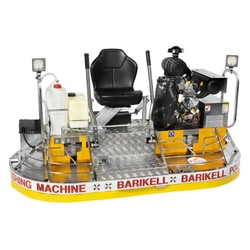
Barikell MP8-90 Concrete Polishing Power Trowel (B&S 35 Hp)
3254zł65,805.00 tax incl. 53 500,00 zł tax excl.View technical data Zobacz szczegóły
- Weight: 293 kg
- Working width: 1800 mm
- Dimensions: 2050 x 1030 x 1040 mm
- Engine power: 25,7 kW | 35 KM
- Engine: B&S Vanguard
Barikell Blade Kit concrete polishing set with 240 mm pad holder (for 1200 mm power trowel)
MB-PD4404zł1,660.50 tax incl. 1 350,00 zł tax excl.View technical data Zobacz szczegóły
- Disc diameter: 240 mm
- Tool clamping: Rzep (velcro)
- Type: Zestaw do przezbrojenia zacieraczki na polerkę
- Kompatybilność: Zacieraczki o średnicy roboczej 1200 mm
Barikell concrete polishing power trowels are floor polishers built on a power trowel: a counter-rotating planetary system with 8 floating Ø 300 mm tool plates replaces the blades and grinds or polishes the slab wet or dry. The range covers the ride-on MP8-75 and MP8-90 Polishing (1500–1800 mm working width), the Moskito 4-60 edge machine and Blade Kit attachments that turn a standard power trowel into a grinder-polisher.
Concrete polishing power trowel — a planetary polisher built on a ride-on trowel
A concrete polishing power trowel is a concrete floor polisher built on a ride-on trowel: instead of troweling blades, each of the two rotors carries four floating 300 mm tool plates (eight in total) and the heads counter-rotate like a planetary grinder. Metal tools, resin tools or pads are attached to the plates with hook-and-loop and the machine runs the successive stages of floor processing: wet grinding, hardening and dry polishing. A working width of 1500–1800 mm means one machine covers a wider strip in a single pass than two conventional 600–750 mm planetary grinders — which is why this type of machine is chosen for large industrial floors: production and storage halls, car parks, logistics centres and big-box retail.
The result is polished (ground) concrete — a floor with closed pores, resistant to abrasion and dusting, with a finish from satin to mirror gloss. The Barikell system comprises the large-area machines MP8-75 Polishing and MP8-90 Polishing, the Moskito 4-60 Polishing edge machine for work along walls, the Power Trowel Blade Kit attachment that turns a standard power trowel into a grinder-polisher, and a full set of tooling and chemicals for two procedures: FAST and PREMIUM. If you need a machine for smaller areas or renovation work, see planetary concrete grinders; a guide to the whole process is in our post concrete grinding and polishing — what is worth knowing.
Types of Barikell concrete polishing trowels
The Polishing family splits into twin-rotor machines for large floors, an edge machine for the zones along walls, and an attachment for the trowels you already own. All of them run on the same hook-and-loop tooling, so one set of Jumpy Hero, Spiral Hero and Hyper King tools serves the whole floor — from the middle of the hall to the edge at the wall.
| Model | Working width | Tooling | Engine / start | Weight | Application |
|---|---|---|---|---|---|
| MP8-90 BS Polishing | 1800 mm (2 × 900 mm) | 8 × Ø 300 mm | Briggs & Stratton, petrol, electric start | 298 kg | the largest floors: halls, warehouses, car parks |
| MP8-90 HN Polishing | 1800 mm (2 × 900 mm) | 8 × Ø 300 mm | Honda 27 HP, petrol, electric start | 298 kg | as above, Honda-engined variant |
| MP8-75 Polishing | 1500 mm (2 × 750 mm) | 8 × Ø 300 mm | 18 HP, petrol, electric start | 212 kg | medium halls, narrower aisles, less weight on the slab |
| Moskito 4-60 Polishing | 600 mm | 600 mm hook-and-loop plate, Jumpy Ø 75 mm discs | 5.5 HP, petrol, recoil start | 49 kg | edges, zones along walls, small rooms |
| Power Trowel Blade Kit | depends on the trowel: 900 or 1200 mm | Ø 240 or Ø 300 mm plates on floating holders | driven by your own trowel | — | upgrade for an existing ride-on or walk-behind trowel |
MP8 machines come as standard with a lifting hook, adjustable LED work lights, a water system for wet work (the MP8-75 is supplied without a tank), a side counterweight, component guards, a high-speed kit and a neoprene splash apron. The machine price does not include batteries. The trowels for conventional finishing of fresh concrete that this family is based on are in the ride-on power trowels category.
Polishing trowel, planetary grinder or hand polisher — which concrete polishing machine to choose
"Concrete polisher" covers three different classes of machine. They differ in working width, weight on the tool and the size of area they are economical for. The table below matches the machine to the job before you compare individual models.
| Machine type | Working width | What for | When to choose |
|---|---|---|---|
| Concrete polishing power trowel (planetary, twin-rotor) | 1500–1800 mm | new large-area industrial floors, grinding and polishing in several stages | when speed over thousands of m² and a seated operator matter |
| Planetary concrete grinder (walk-behind) | 450–750 mm | renovation, removing coatings and adhesives, small and medium floors, indoor work | when you need high pressure per segment and electric drive in closed halls — see planetary concrete grinders |
| Hand polisher / angle grinder with a disc | 125–250 mm | stairs, sills, details, touch-ups at walls and columns | when the area is measured in metres, not thousands of metres — tooling in polishing and grinding accessories |
On a large hall these machines work together in practice: the polishing trowel does the open floor, the Moskito 4-60 Polishing or an edge grinder reaches the walls, and a hand polisher finishes the corners. The key is keeping the same tool sequence on every machine so the edge does not differ in gloss from the middle of the floor.
FAST and PREMIUM procedures — four stages of polishing concrete with a trowel
Barikell describes the process as a sequence of four stages, in two tempo variants. FAST is for quickly achieving a glossy, protected surface; PREMIUM has a longer grinding and polishing sequence and gives higher uniformity and gloss. In both variants stages 2 and 4 are chemical: the lithium densifier penetrates the concrete and reacts with free lime to form harder compounds in the pores, and the guard closes the surface against stains and makes cleaning easier.
| Stage | FAST procedure | PREMIUM procedure | Mode |
|---|---|---|---|
| 1. Grinding | Spiral Hero 0 (metal tool, Ø 240 or Ø 300 mm) | Jumpy Hero 1 (Ø 75 mm) | wet, using the machine's water system |
| 2. Hardening | Concrete Hardener (lithium densifier) | Concrete Hardener (lithium densifier) | applied to a clean, dried floor |
| 3. Polishing | Hyper King 2 (Ø 240 or Ø 300 mm) | Jumpy Hero 2, 3 and 4 — successively finer grits | dry, with dust extraction to an industrial vacuum |
| 4. Protection | Concrete Guard Lithium (protection and gloss) | Concrete Guard Lithium (protection and gloss) | applied and buffed with microfibre |
The stages are a process outline — grit selection and the number of passes depend on concrete hardness, floor age and the expected finish. Tools and pads for both procedures are in the diamond segments and pads category, the densifier and guard in polishing chemicals: Concrete Hardener Lithium and Concrete Guard Lithium PRO. For dry work the machine has an extraction port under the chassis — connect an industrial vacuum for grinders to it.
Power Trowel Blade Kit — how to turn a standard power trowel into a concrete polisher
The Blade Kit is a set of arms with floating tool holders and a flexible foam backing that mounts in place of the blades of a ride-on or walk-behind power trowel. The machine you already use for troweling fresh concrete can then, once the slab has cured, grind and polish it with the same Jumpy Hero, Spiral Hero and Hyper King tooling as the dedicated Polishing machines. Available configurations: Ø 240 mm plates for a 1200 mm trowel, Ø 240 mm plates for a 900 mm trowel and Ø 300 mm plates for a 900 mm trowel; each diameter has its own hook-and-loop interface (Ø 240 or Ø 300 mm) that protects the hook-and-loop and lets you swap a tool in seconds.
Floating holders follow local unevenness of the substrate and the foam backing evens out the pressure — tools wear uniformly and the floor shows no strips of different gloss. Kit compatibility must be confirmed for the specific machine (rotor diameter, number and spacing of arms), so quote your trowel model when ordering. The Blade Kit is the natural first step for flooring contractors who want to add polishing to their services without buying a separate machine; once polishing becomes a regular service, a dedicated MP8-75 or MP8-90 Polishing brings the full package: water system, LED lights, dust extraction and dust guards.
What sets the Polishing trowels apart
Polishing generates dust and cement slurry that a conventional trowel never has to cope with — so Polishing machines have a frame closed from underneath, external guards for the gearboxes, engine and operator station, a transparent dust shield and a neoprene splash apron. Powerful LED lights illuminate the strip being worked, which matters in polishing: the operator has to see gloss uniformity in real time, not after the job is done.
The tool drive is a counter-rotating planetary system with a reinforced spider and a toothed-belt clutch; the transmission handles higher loads than in troweling and a protective tunnel shields the gearboxes. The chrome-plated structure is easier to wash and resistant to the chemicals used in stages 2 and 4. For moving between zones there is a drawbar, three pneumatic wheels and a removable front wheel; a transport trolley and a service stand that tilts the machine to 45 degrees for changing all eight tools at once are available separately for the MP8-75 and MP8-90. The tool plates have a polycarbonate interface protecting the hook-and-loop, and tools are changed without spanners.
Frequently asked questions about concrete polishing trowels
What is the best way to polish concrete over a large area?
On large industrial floors concrete is polished fastest with a concrete polishing power trowel — a twin-rotor planetary machine with a 1500–1800 mm working width and eight Ø 300 mm tool plates that take, in turn, metal tools for wet grinding and resin tools for dry polishing. On areas measured in hundreds of square metres and on renovation jobs a 450–750 mm walk-behind planetary grinder is enough, while edges and details are handled by a 600 mm edge machine or a hand polisher with a 125–250 mm disc. The choice depends on area, access to electricity and whether the floor is new or needs an old coating removed.
Can existing, old concrete be polished?
An existing concrete floor can be polished if it is sound, not crumbling and free of extensive cracks or spalls — cracks and repair patches remain visible after polishing because the process exposes the structure of the concrete. Old concrete usually needs an extra preliminary stage: removing coatings, adhesives or laitance with a coarser metal tool before entering the FAST or PREMIUM procedure. A freshly poured slab should reach its design strength before grinding, which with ordinary cement takes about 28 days; polishing earlier pulls aggregate out instead of cutting it.
How is polished concrete made, step by step?
Polished concrete is produced in four stages: wet grinding with a metal tool (in the Barikell system Spiral Hero 0 in the FAST procedure or Jumpy Hero 1 in PREMIUM), hardening the floor with the lithium densifier Concrete Hardener, dry polishing with resin tools of increasing grit (Hyper King 2 or Jumpy Hero 2, 3 and 4), and protecting it with Concrete Guard Lithium buffed in with microfibre. Each stage is several machine passes with overlapping strips; between stages 1 and 3 the floor must be thoroughly washed and dried so the densifier can penetrate the pores. The number of grits determines the finish — from satin to mirror.
What are the drawbacks of polished concrete?
Polished concrete has three typical limitations: when wet it is more slippery than a matt floor, so in wet zones a lower gloss level or an anti-slip treatment is used; it exposes every shrinkage crack, repair and mix variation, so it requires a carefully placed slab; and it needs a sealer and periodic renewal of the protective layer, because without it oil or acid stains penetrate the pores. The initial workload is higher than for a resin coating, but the floor does not peel, does not dust and lasts as long as the concrete itself — which balances the cost of the first execution.
Should concrete be polished wet or dry?
Initial grinding with a metal tool is done wet — water from the machine's system cools the segments, binds the dust and extends tool life; it produces cement slurry that has to be collected and disposed of. Polishing with resins is done dry, because only then does the surface take on a gloss, and the dust is extracted from under the chassis to an industrial vacuum with a HEPA filter. Polishing trowels have both modes as standard: a tank with water system and an extraction port. The Barikell FAST and PREMIUM procedures specify stage 1 wet and stage 3 dry.
How does a polishing trowel differ from a planetary grinder?
Both machines have a planetary tool arrangement, but the polishing trowel is a ride-on machine with two rotors and a 1500–1800 mm working width, petrol-driven, on which the operator sits — it is built for large, open floors. A planetary grinder is a walk-behind machine 450–750 mm wide, usually electric, with more pressure per segment, so it copes better with removing coatings, unevenness and work in closed rooms without ventilation. The trowel wins on speed over thousands of metres, the grinder on versatility and renovation work.
Does the Blade Kit fit every power trowel?
The Power Trowel Blade Kit is offered in three configurations: Ø 240 mm plates for 1200 mm trowels, Ø 240 mm plates for 900 mm trowels and Ø 300 mm plates for 900 mm trowels — for ride-on and walk-behind machines. The kit mounts in place of the blades, so it must match the rotor diameter, the number of spider arms and their spacing; the manufacturer states that compatibility must be confirmed for the specific machine. When ordering, quote the make and model of your trowel and the number of blades per rotor and we will select the configuration or tell you if there is no match for that machine.
Rent a concrete polisher or buy your own machine?
Renting makes sense for a one-off job of a few hundred square metres when you do not plan further work of this type. A flooring contractor who already trowels concrete and wants to add polishing has a cheaper middle route: a Blade Kit fitted to the ride-on or walk-behind trowel they own, plus a tool set for the FAST or PREMIUM procedure. Once polishing becomes a regular service on large halls, a dedicated Polishing trowel with water system, extraction, LED lighting and dust guards pays for itself through working speed and lower tool wear thanks to the floating holders.
What tooling goes on a polishing trowel?
Three kinds of tool attach by hook-and-loop to the eight Ø 300 mm plates: Spiral Hero 0 (metal, Ø 240 or 300 mm) for wet grinding, Hyper King 2 (Ø 240 or 300 mm) for dry polishing in the FAST procedure, and Jumpy Hero resin discs in four grits 1–4 (Ø 75 mm) for the PREMIUM procedure. Between the plate and the tool runs a hook-and-loop interface Ø 240 or Ø 300 mm that protects the hook-and-loop and speeds up changes. Microfibre holders and antistatic cloths are used to apply the densifier and the guard. The same tool set fits the Blade Kit and — in the Ø 75 mm version — the Moskito 4-60 Polishing edge machine.
Why buy a concrete polishing trowel from NORWIT.PL
We are the Polish distributor of the Italian brand Barikell and have supplied its trowels, pans and blades to flooring contractors for years — polishing is the natural extension of that range with machines, tooling and chemicals from one system. We help you choose the FAST or PREMIUM procedure for the state of the concrete and the expected finish, confirm Blade Kit compatibility with your trowel and provide parts and service. The category is part of our wider range of power trowels; if you are still planning the floor, start with the guide when to trowel concrete and which trowel to use. Orders are processed online with nationwide delivery; parameters and compatibility are confirmed before dispatch.